2. Rebuilding Relations with Asian Countries
Having regained its independence, while advancing its economic recovery Japan worked to rebuild friendly relations with Asian nations.
Japan concluded separate peace treaties with countries that did not sign the Treaty of San Francisco. In 1952, Japan concluded a peace treaty with India (“Treaty of Peace between the Governments of Japan and India and Related Documents”) and a peace treaty with the ROC (“Treaty of Peace between the Republic of China and Japan”). In 1954, Japan concluded a peace treaty with Burma (now Myanmar) (“Treaty of Peace between Japan and the Union of Burma”), along with an agreement on reparations and economic cooperation. In 1956, Japan concluded a peace treaty with Indonesia (“Treaty of Peace between Japan and the Republic of Indonesia”), also accompanied by an agreement on reparations and economic cooperation.
As to South Korea, the “Treaty on Basic Relations between Japan and the Republic of Korea” entered into force in December 1965, normalizing diplomatic relations between the two countries.With respect to the PRC, following a history of economic exchanges, the “Joint Communiqué of the Government of Japan and the Government of the People’s Republic of China” was signed in 1972, leading to the normalization of diplomatic relations.
Looking next at reparations and economic cooperation, Japan concluded agreements over these areas based on the Treaty of San Francisco with Burma (effective 1954), the Philippines (effective 1956), Indonesia (effective 1958), and South Vietnam (effective 1960).
Meanwhile, Japan provided grant aid and other forms of economic cooperation to Laos and Cambodia—which had waived their claims for reparations—as well as to countries whose claims were unrelated to those under the Treaty of San Francisco. An agreement was concluded with Thailand on settling the problem of outstanding debts from military expenditure procurements (the “special-yen problem”). As to South Korea, which had been under Japanese rule, economic cooperation agreements—both grant and loan-based—were signed upon the normalization of diplomatic relations.
To Malaysia and Singapore—which were part of Britain’s Federation of Malaya at the time of the signing of the Treaty of San Francisco—Japan provided services and goods in the form of an economic cooperation agreement. Diplomatic relations with North Vietnam were established in 1973. Agreements for grant-based economic cooperation were concluded with North Vietnam in 1975 and with a unified Vietnam (Socialist Republic of Vietnam) in 1976.
TABLE: List of Treaties and Agreements Signed with Asian Countries
| Year | Month | Item |
|---|---|---|
| 1951 | September | Signing of the Treaty of San Francisco (entered into force in April 1952) |
| 1952 | April | Signing of the Treaty of Peace between the Republic of China and Japan (entered into force in August of the same year) |
| June | Signing of the Treaty of Peace between the Governments of Japan and India (entered into force in August of the same year) | |
| 1953 | July | Conclusion of the Korean War Armistice Agreement |
| 1954 | November | Signing of the Treaty of Peace between Japan and the Union of Burma along with an agreement on reparations and economic cooperation (effective April 1955) |
| 1956 | May | Signing of the Reparations Agreement between the Republic of the Philippines and Japan (entered into force in July of the same year) |
| 1958 | January | Signing of the Treaty of Peace between Japan and the Republic of Indonesia, along with a reparations agreement (entered into force in April of the same year) |
| October | Signing of the Agreement on Economic and Technical Cooperation with Laos (effective January 1959) | |
| 1959 | March | Signing of the Agreement on Economic and Technical Cooperation with Cambodia (effective July of the same year) |
| May | Signing of reparations and loan agreements with South Vietnam (effective January 1960) | |
| 1962 | January | Signing of a new agreement on the settlement of “special yen” claims with Thailand (effective in May of the same year) |
| November | Signing of the memorandum on long-term comprehensive trade between Japan and China (the so-called “LT Memorandum”) | |
| 1965 | June | Signing of the Treaty on Basic Relations between Japan and South Korea, along with agreements on claims and economic cooperation (effective December of the same year) |
| 1967 | September | Signing of an agreement with Malaysia (entered into force in May 1968) |
| September | Signing of an agreement with Singapore (entered into force in May1968) | |
| 1969 | April | Signing of an agreement with the United States concerning Micronesia (effective July of the same year) |
| 1972 | February | Signing of letters exchanged with Mongolia regarding the establishment of diplomatic relations |
| September | Signing of a joint communiqué between Japan and the People’s Republic of China (normalization of Sino-Japanese relations) | |
| 1973 | September | Signing of letters exchanged with North Vietnam concerning the establishment of diplomatic relations |
| 1975 | October | Signing of letters exchanged with North Vietnam regarding economic cooperation |
| 1976 | September | Signing of letters exchanged with the Socialist Republic of Vietnam regarding economic cooperation |
| 1977 | March | Signing of an agreement between Japan and Mongolia on economic cooperation (entered into force in August of the same year) |
*Click the links to view explanations and materials from “JACAR Learning.”
Through the JACAR digital archive, you can view documents related to the negotiation and implementation processes of peace treaties and reparations agreements with various countries, as well as the original treaties, within the file collections listed below. There are still many documents not yet available through the JACAR archive; as the institutions that hold the original copies provide digital images of those records, in due course they will in turn be made available through JACAR’s digital archive.
Diplomatic Archives of the Ministory of Foreign Affairs > Postwar Treatiy > Bilateral Treaty > Asia
What follows below is a selection of the records already available through the JACAR digital archive.
◆Treaty of Peace between the Republic of China and Japan, with explanatory materials for domestic audiences
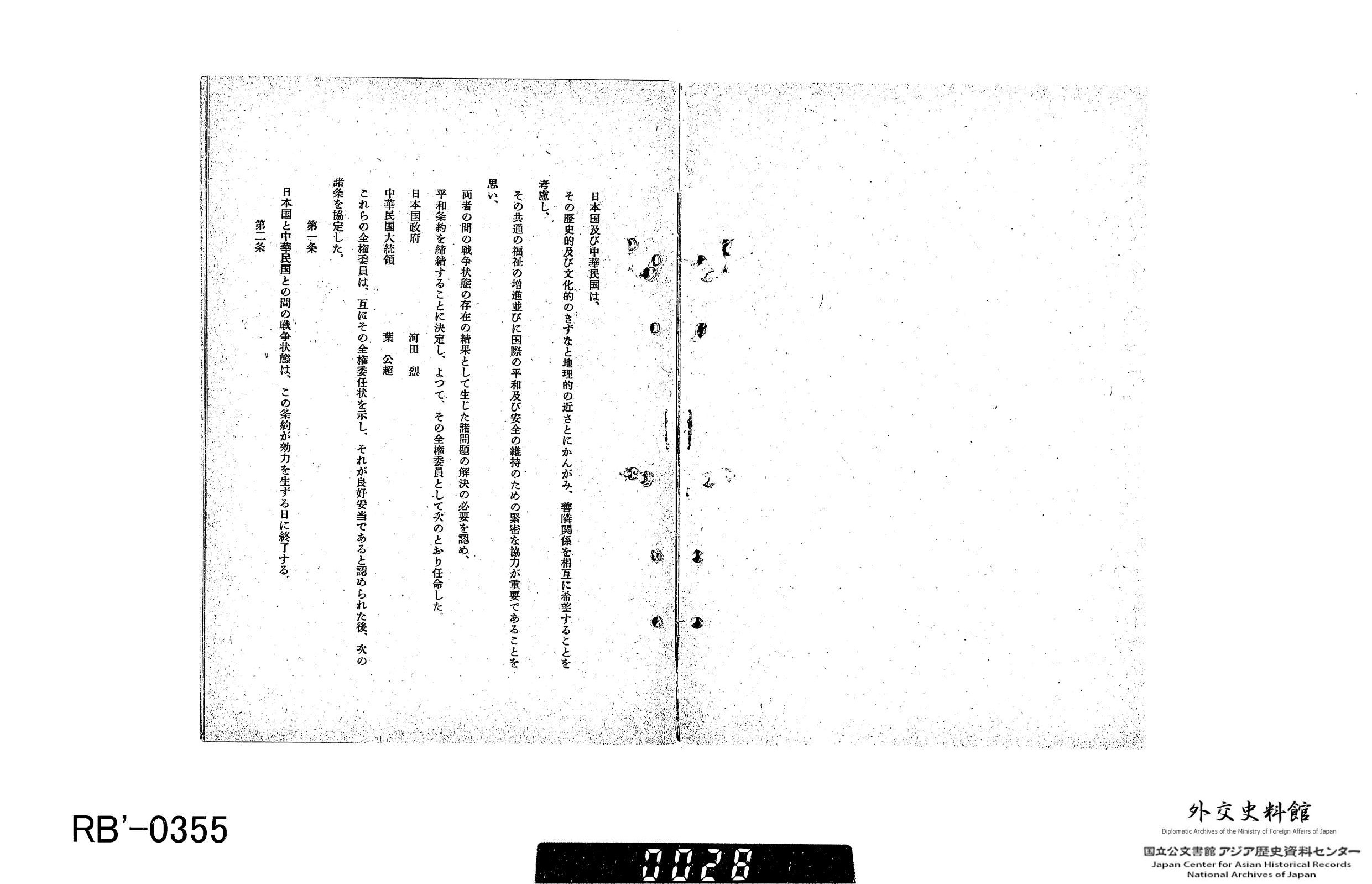
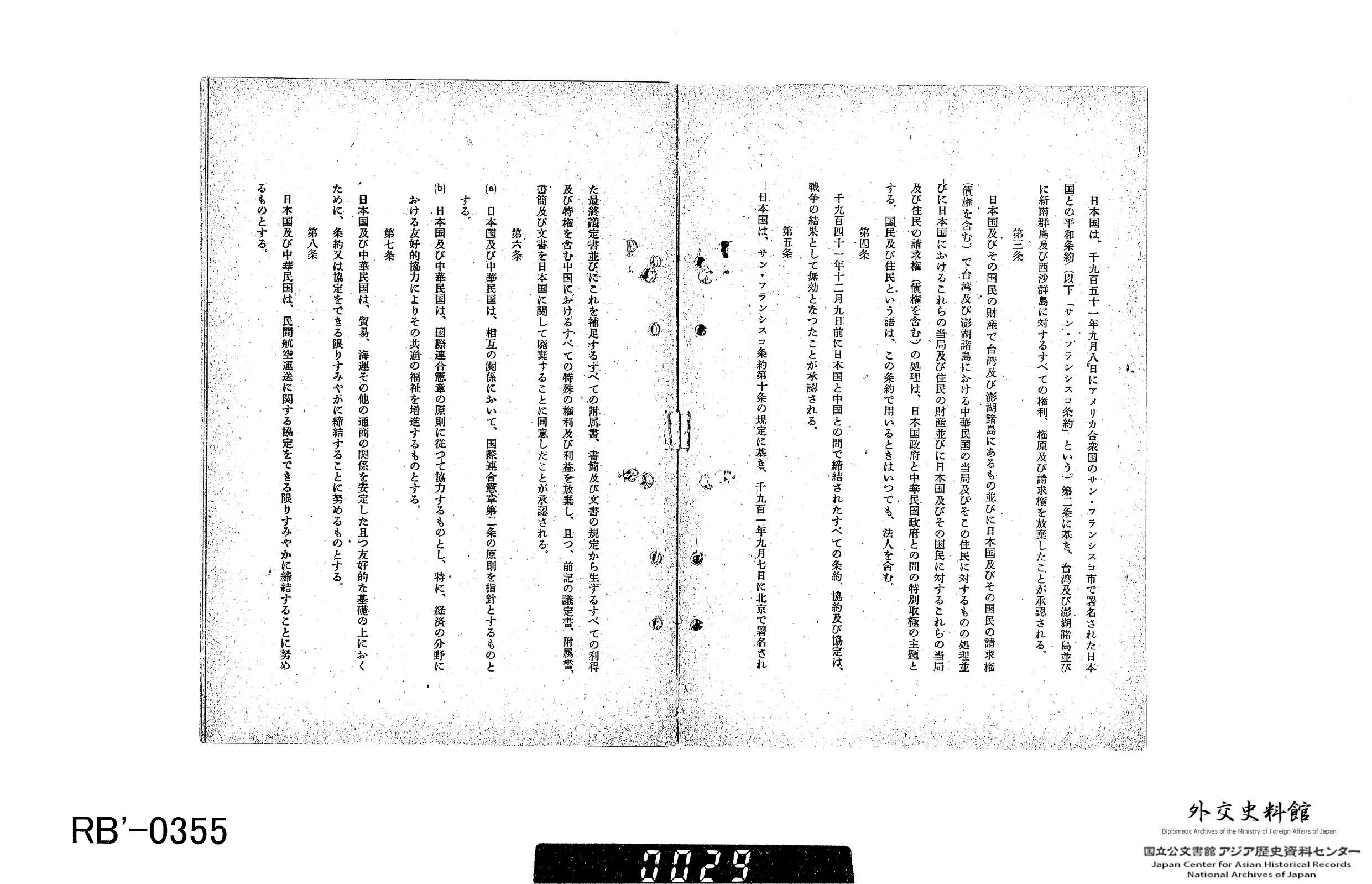
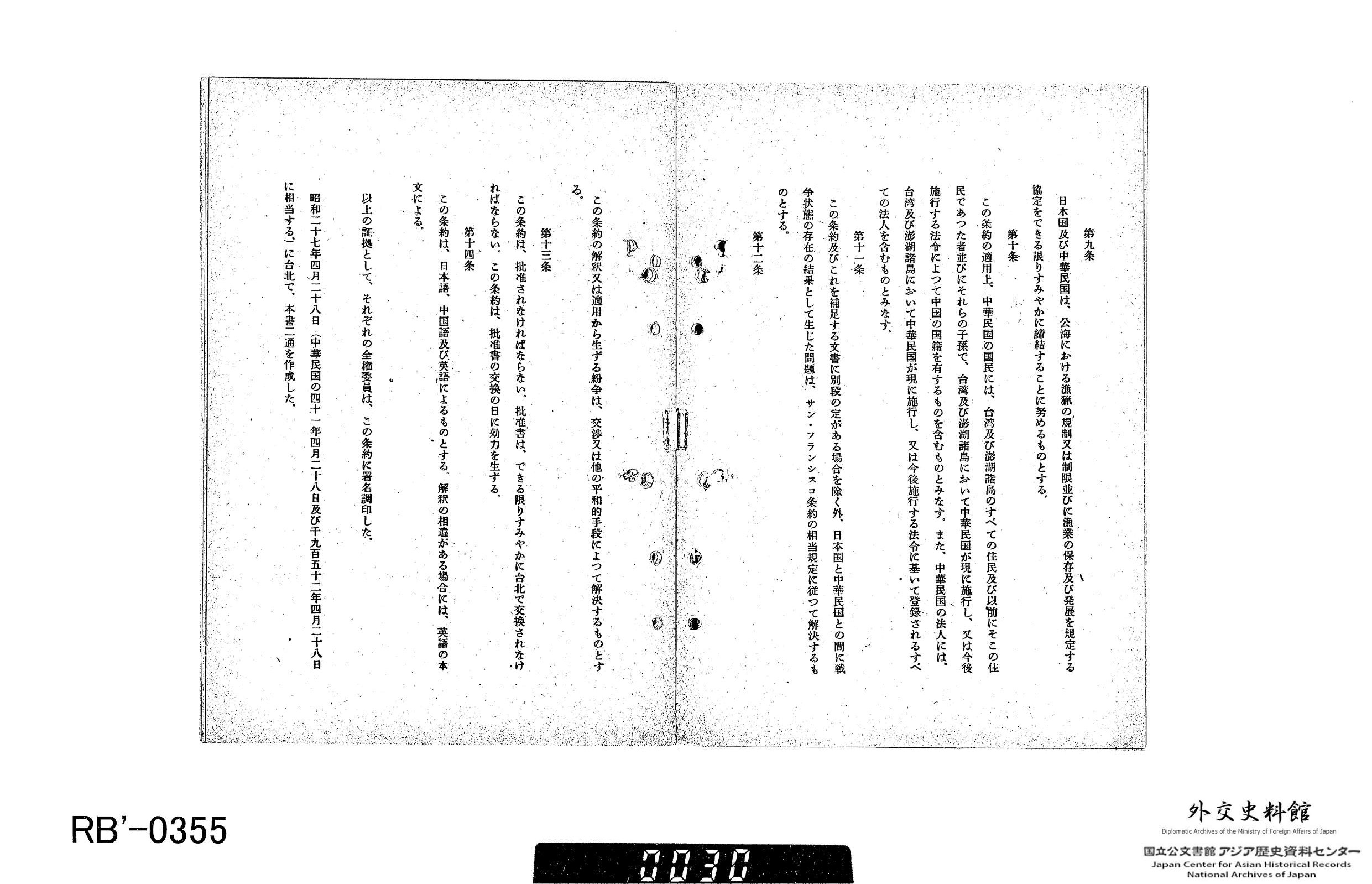
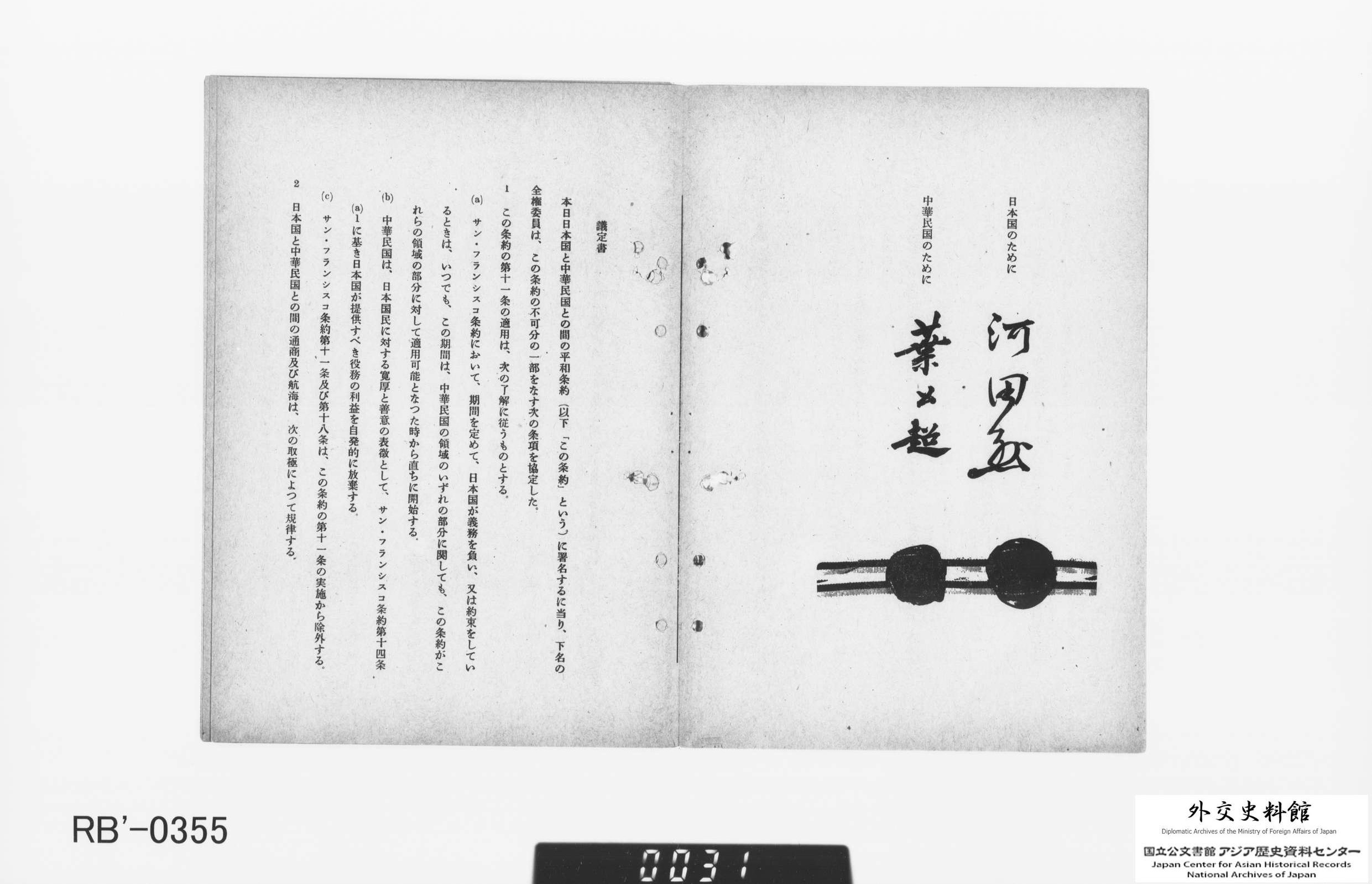
[Document 9] Item: “(No title)/(1) Peace Treaty between Japan and the Republic of China (Text of the Treaty)” B21010300200 (Images 4–7)
[Document 10] Item: “(No title)/(2) Expected Questions and Answers of "the Peace Treaty between Japan and the Republic of China" (Prepared on February 11, 1958)/1.(No title)/(Partition 1)” B21010323300 (Images 46–48)
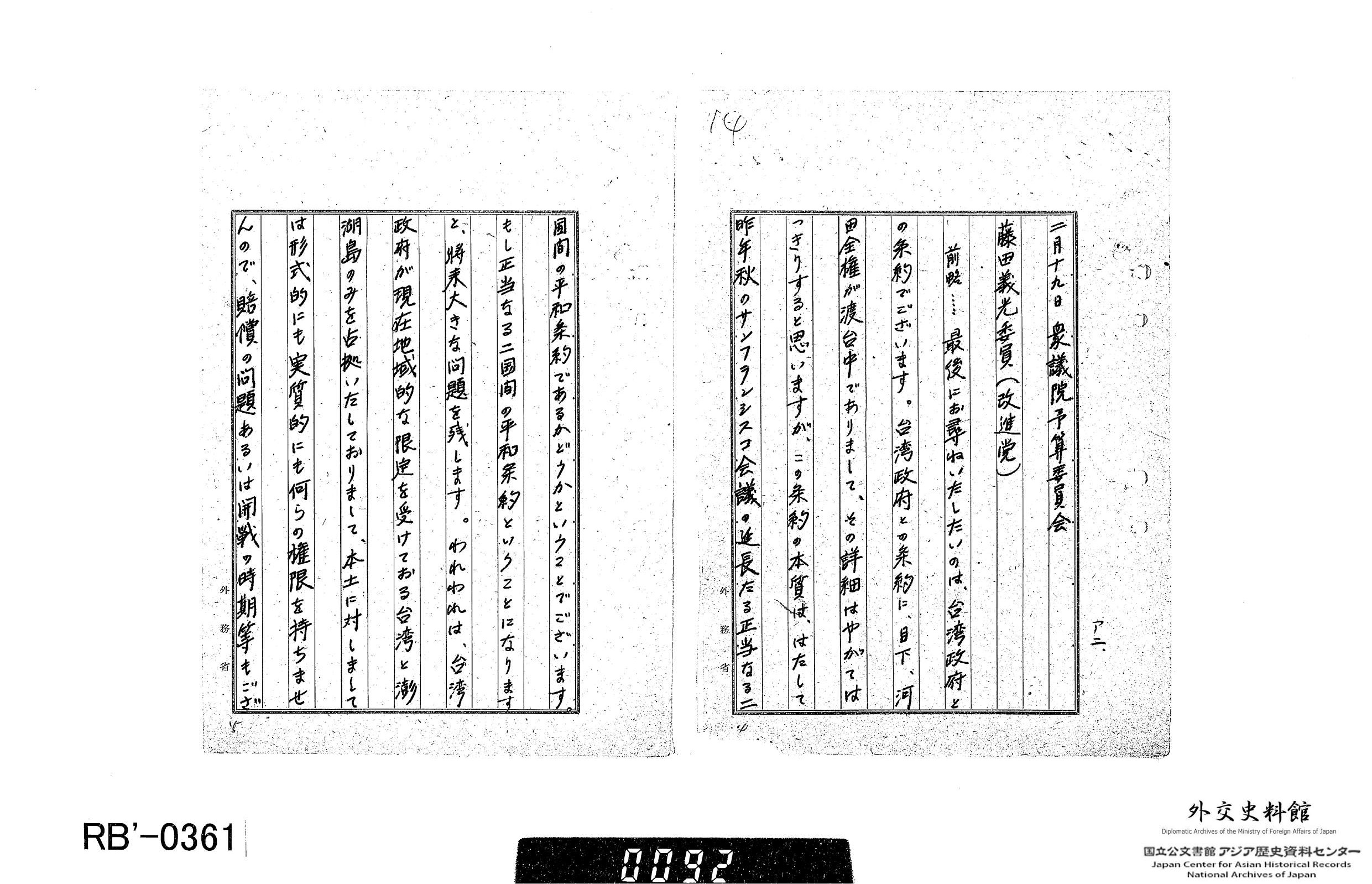
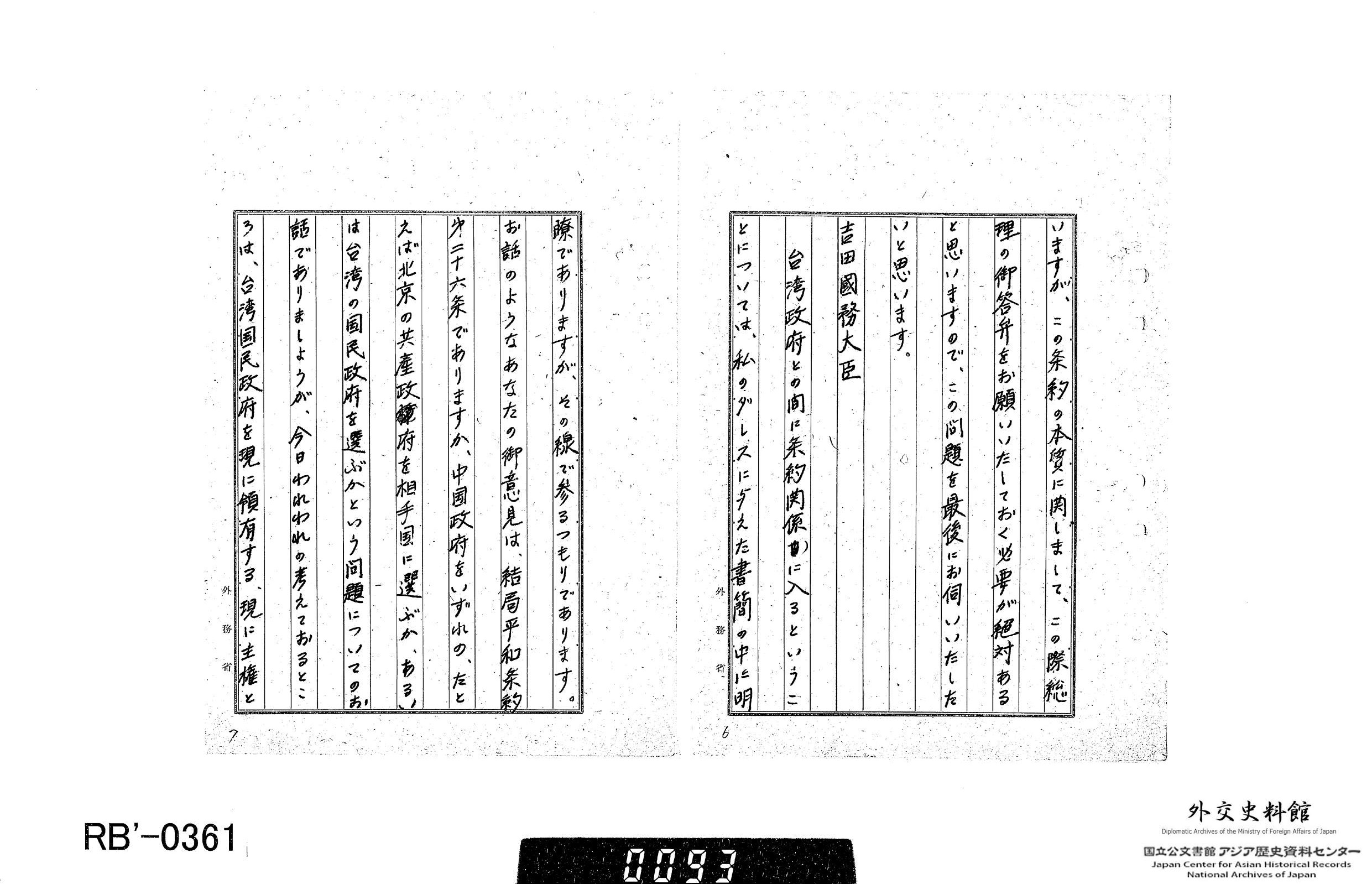
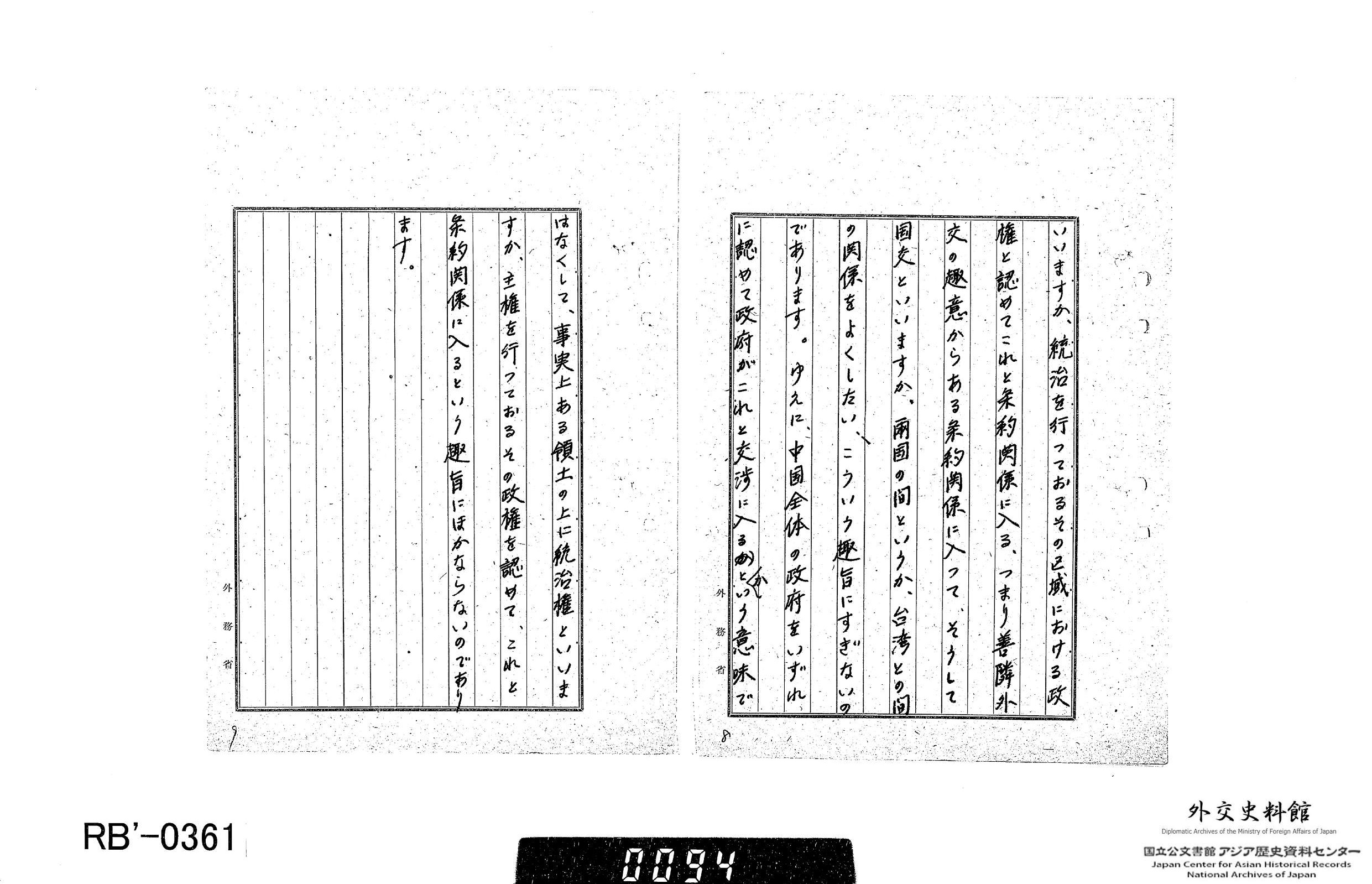
Although the ROC was not invited to the San Francisco Peace Conference, Japan concluded a peace treaty with it in 1952, thereby bringing the state of war between the two to an end. [Document 9] is the text of the ROC-Japan peace treaty.
[Document 10] is a record of Prime Minister Yoshida’s response, bound in the records related to the Diet deliberations on the treaty (from February 19, House of Representatives Budget Committee). He explained that this did not mean that Japan was recognizing the Nationalist Government as the government of all of China and negotiating with it. Rather, it was a matter of “our recognizing Taiwan’s Nationalist government as the government of the territory it currently possesses—that is, the territory over which it currently has sovereignty, or rather, over which it exercises governance—and enter into treaty relations with it.”
Furthermore, at the House of Councillors Foreign Affairs Committee meeting on June 26, Yoshida expressed his hope for the resumption of relations with China as a whole.
◆Promotion of Trade with the People’s Republic of China
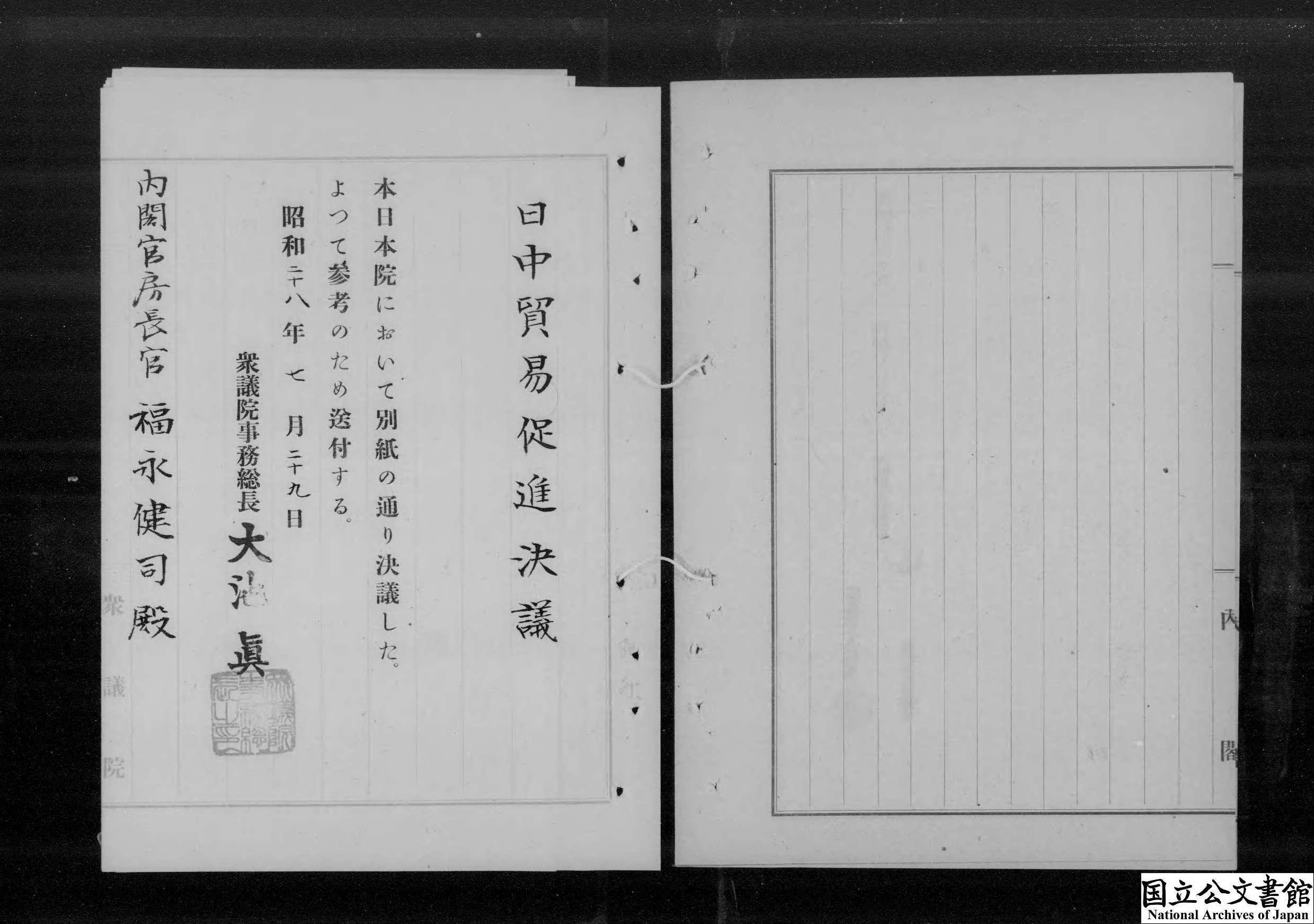
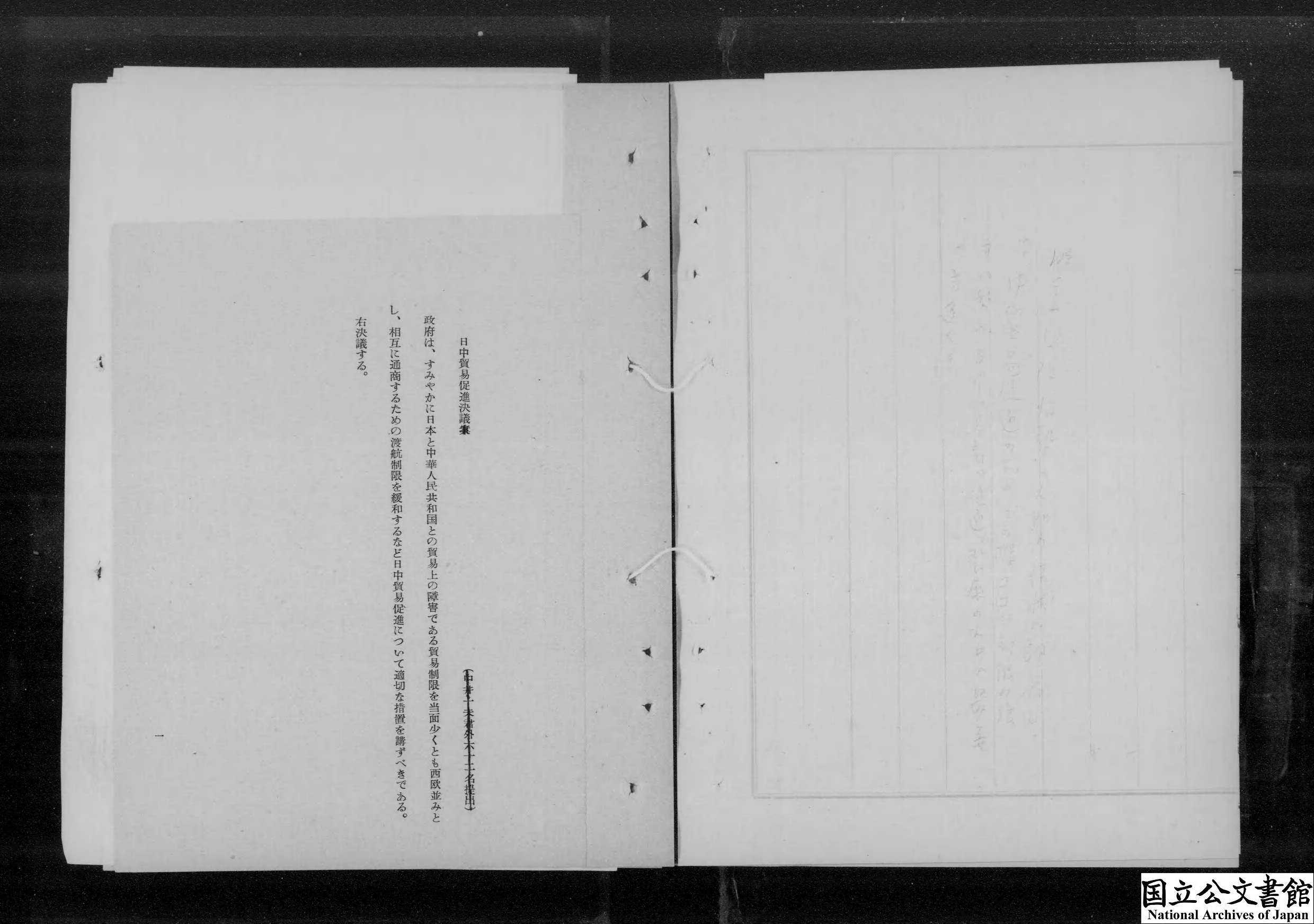
[Document 11] Item: “Resolution of the House of Representatives: Resolution on Promoting Trade between Japan and China” A21100497800 (Images 2–3)
[Document 12] Item: “Japan's Trade with Chinese Communist Party, Vol. 2: Division 5” B24010235700 (Images 2, 23, and 24)
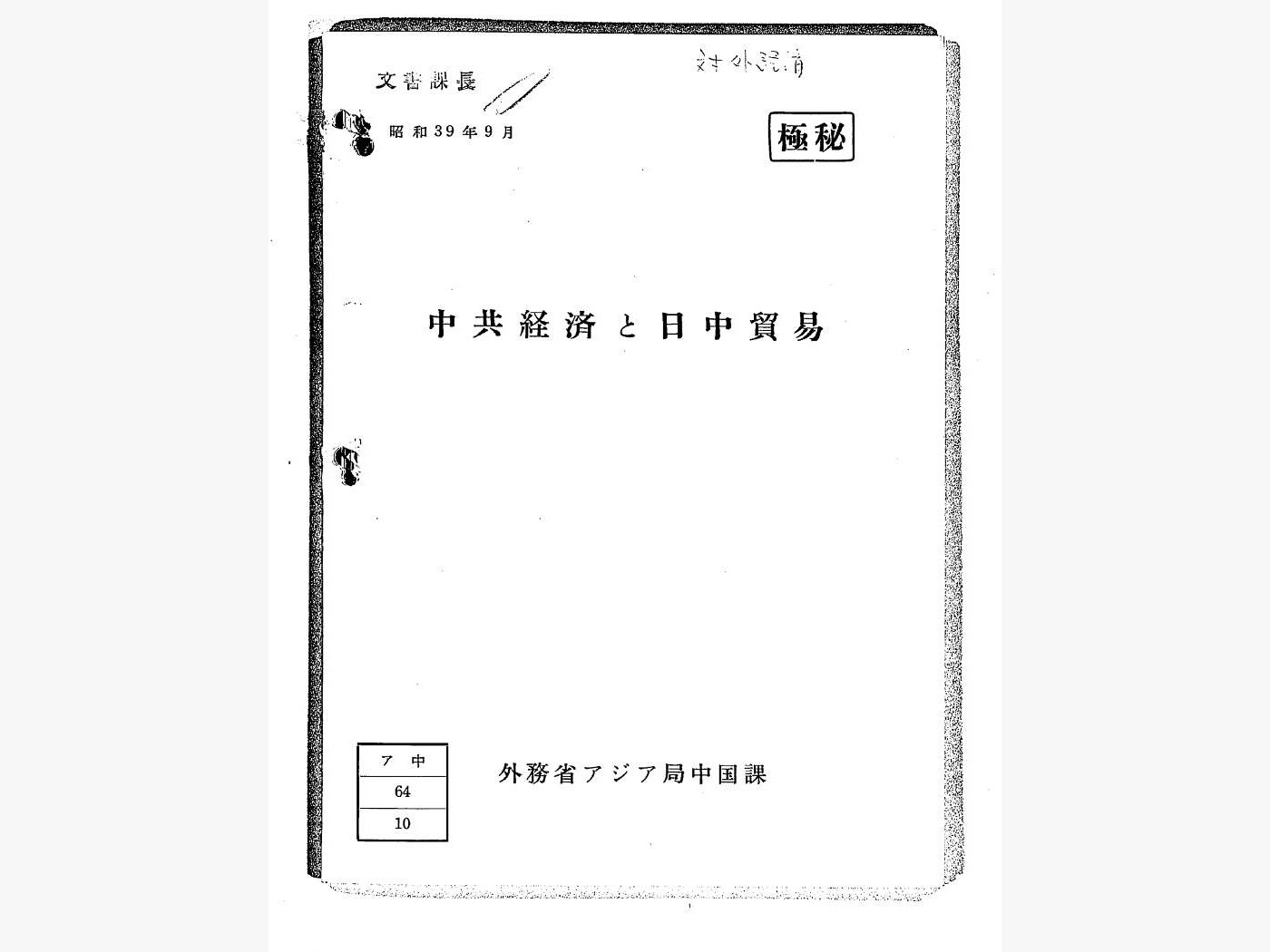
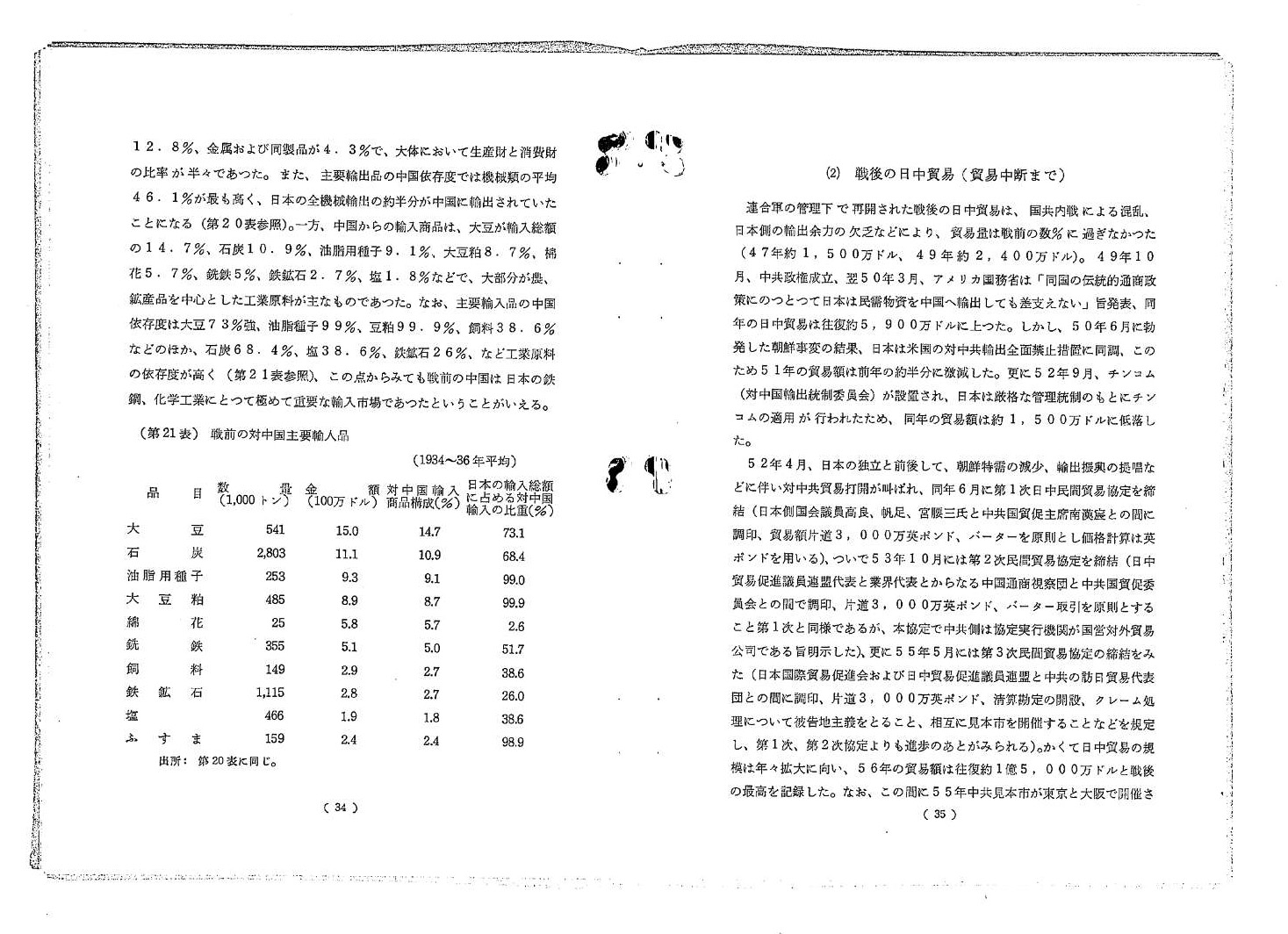
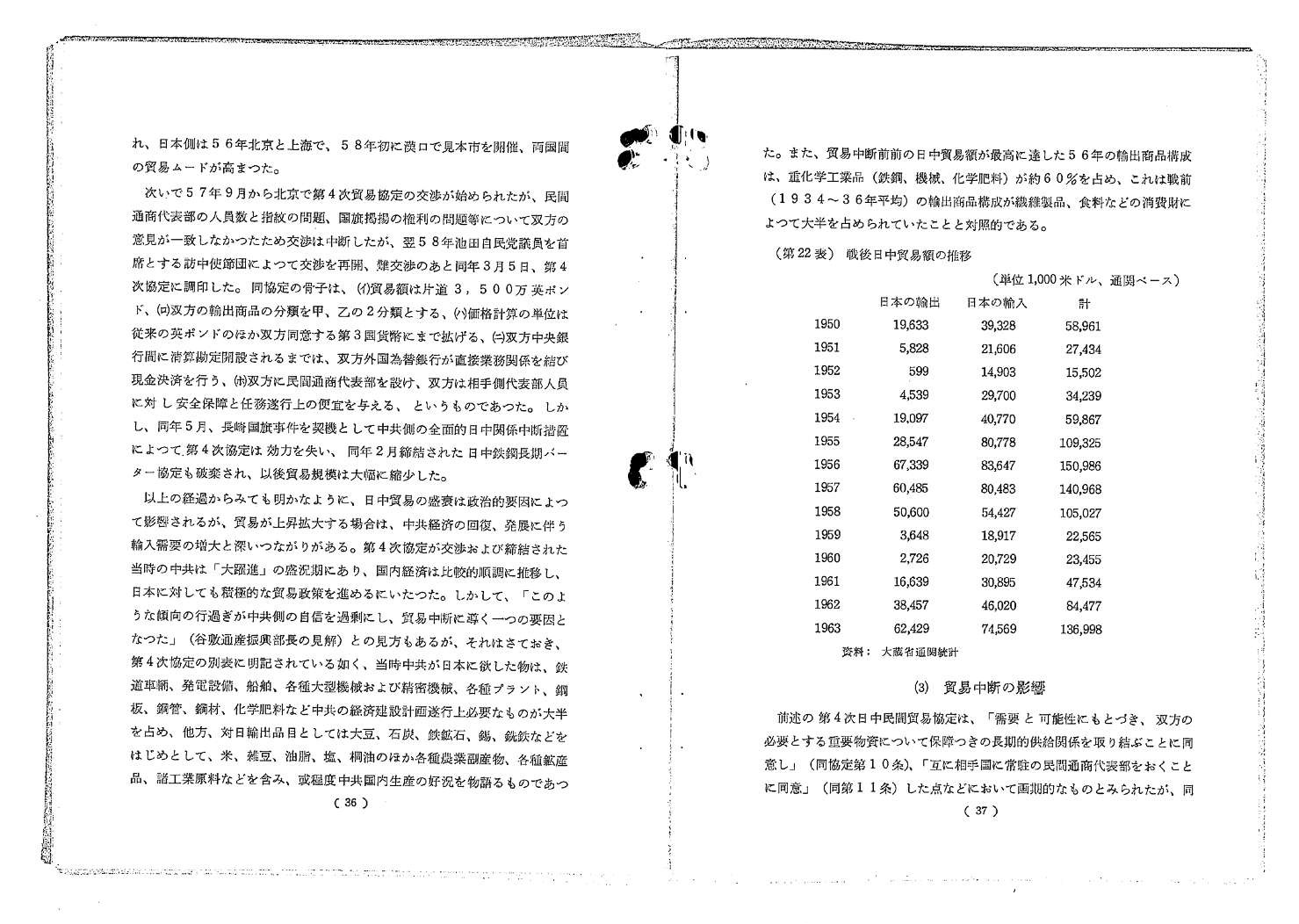
Although it took time to normalize diplomatic relations with the PRC—the process was not completed until 1972—amid the ongoing Cold War between East and West, bilateral economic exchanges proceeded. At the time, trade between Japan and the PRC was restricted by the U.S.-led Committee on Commerce with Communist Countries (COCOM), but in 1952, a delegation of Diet members visiting China concluded the first Japan-China private trade agreement. At the end of July 1953, both houses of the Diet passed resolutions to promote Japan-China trade, and lawmakers expressed their desire for, among other things, the easing of trade restrictions. [Document 11] is the text of the House of Representatives resolution sent to the Cabinet (the House of Councillors resolution can be found at Ref. A21100497900).
Subsequently, a second Japan-China private-sector trade agreement was concluded in October 1953, followed by a third in May 1955, and trade between Japan and the PRC would continue to advance. [Document 12] is an excerpt from a report titled, “Chukyō keizai to Nitchū boeki [The economy of the People’s Republic of China and Japan-China trade],” prepared by MOFA in 1964, that details the events of this period. It notes that the trade volume had expanded from US$15 million in 1952 to US$150 million by 1956.
◆The Korean War Armistice and Japanese Diplomatic Policy
[Document 13] Item: “6. Impact of the Truce of Korean War on Japan / (Untitled)” B20010148900 (Images 26–28)
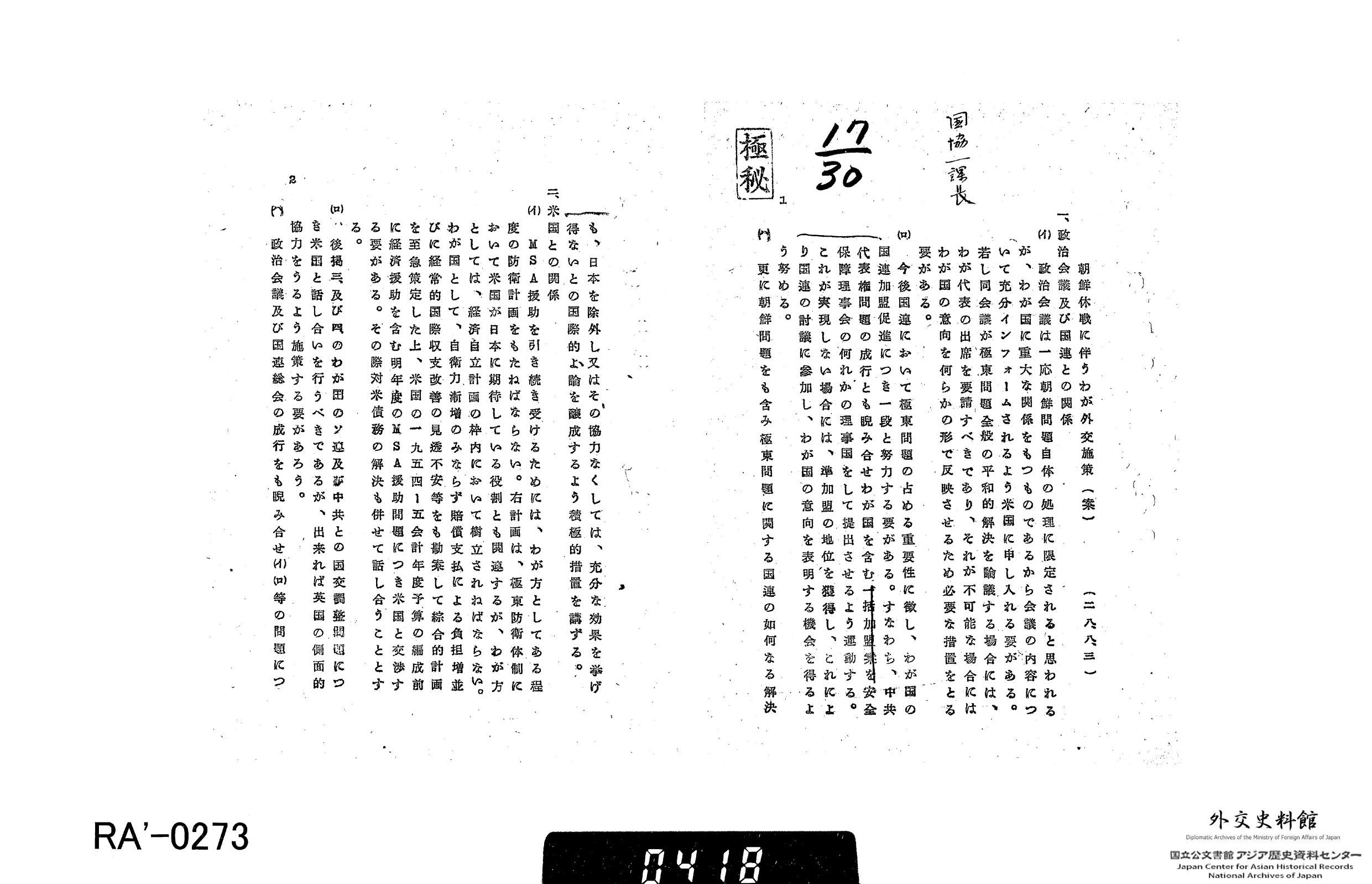
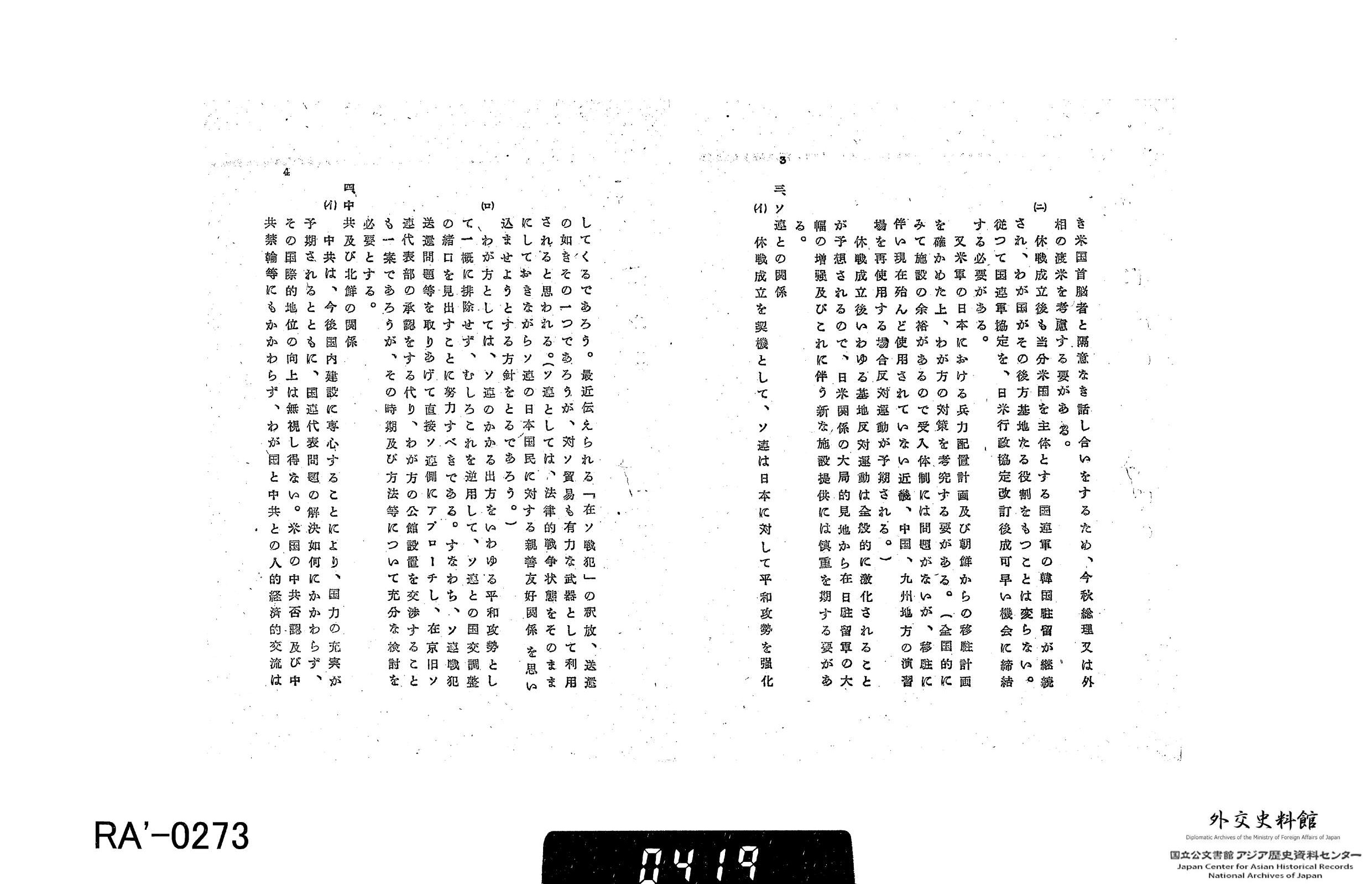
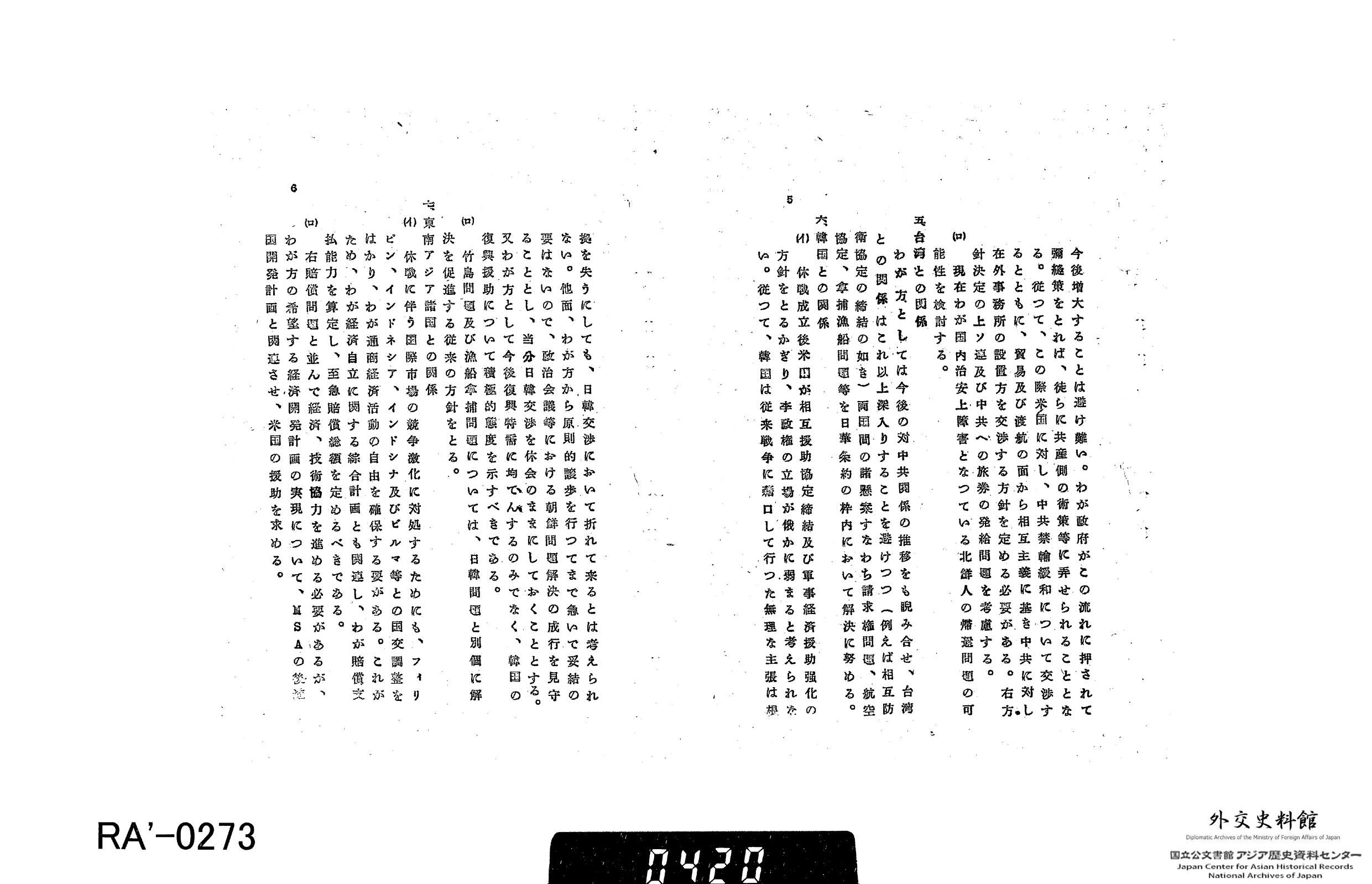
After Japan’s defeat in World War II, the Korean Peninsula was divided and occupied by the United States and the Soviet Union. The Republic of Korea (South Korea) and the Democratic People’s Republic of Korea (North Korea) were established in 1948. The Korean War began in June 1950, and an armistice agreement was signed on July 27, 1953.
[Document 13] comprises a draft (dated August 3) of the diplomatic measures that Japan would undertake following the armistice. It summarizes proposed diplomatic measures for the United Nations, the United States, the Soviet Union, the PRC, North Korea, Taiwan, South Korea, and the countries of Southeast Asia.
◆Record summarizing the history of reparations negotiations with Indonesia
[Document 14] Item: “6. Record: ‘History of Reparations Negotiations between Japan and Indonesia’ (March 1955 [Shōwa 30]) Asian Affairs Bureau, Third Section” B24091076600 (Images 2, 6, and 7)
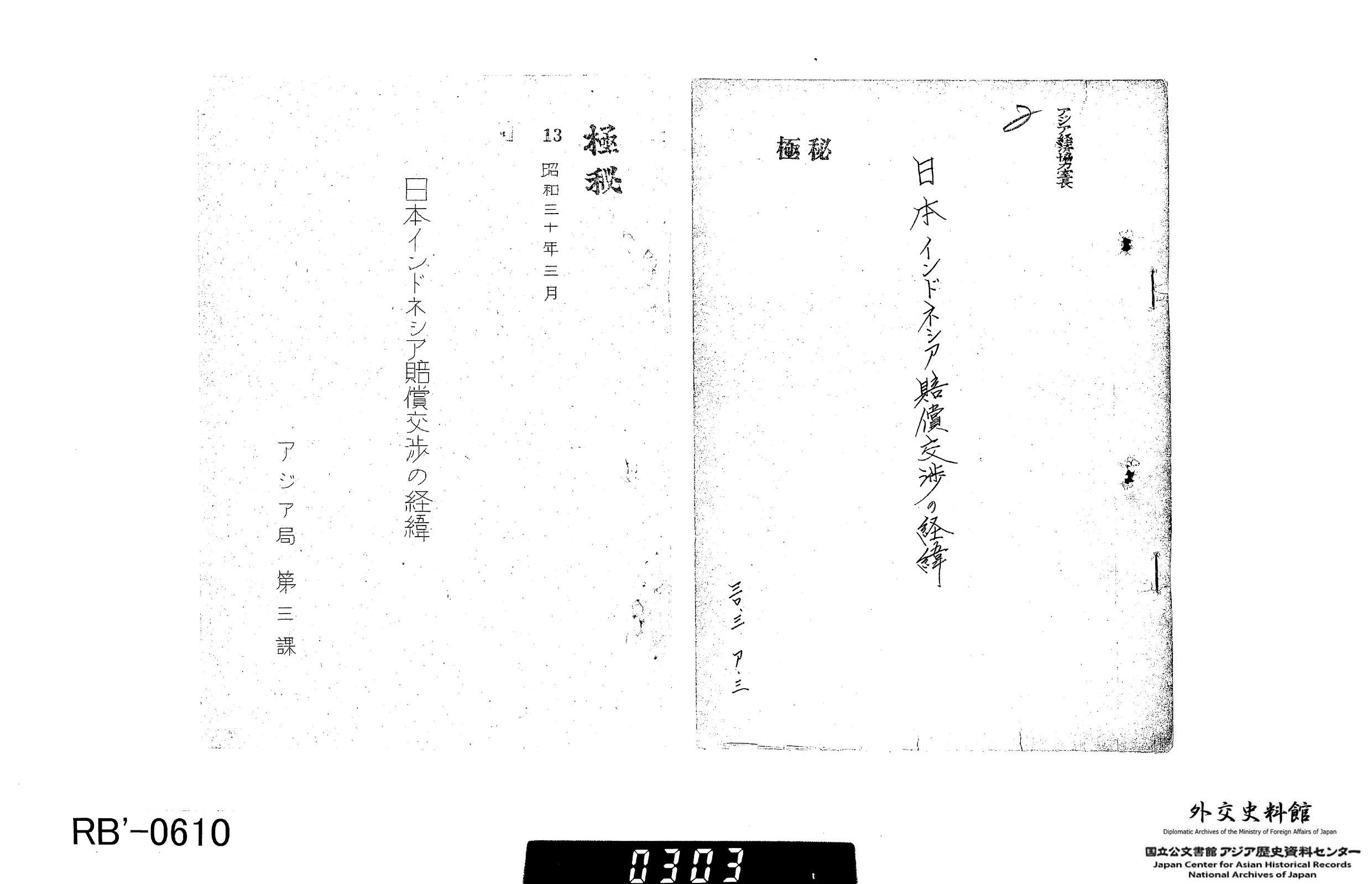
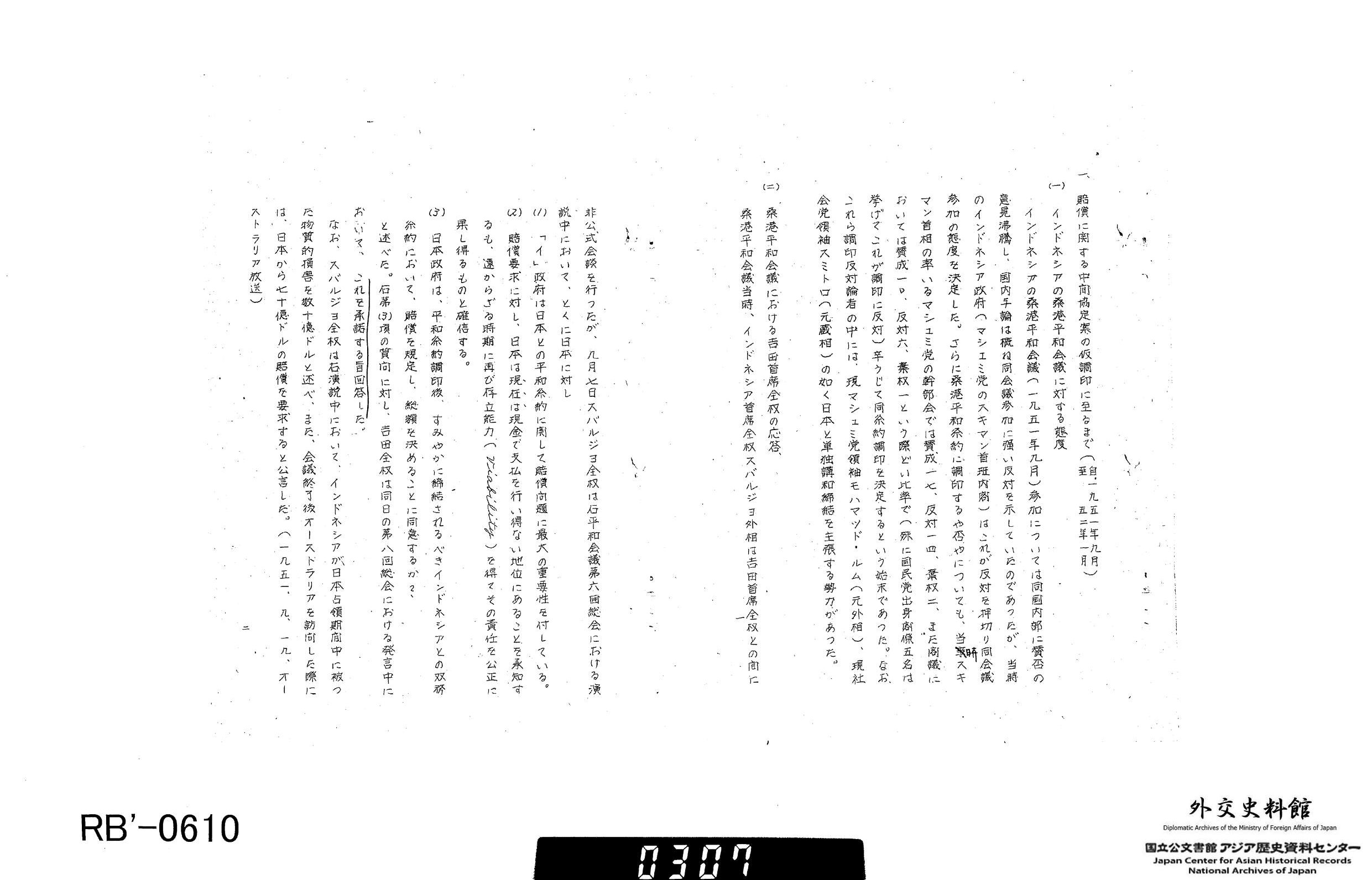
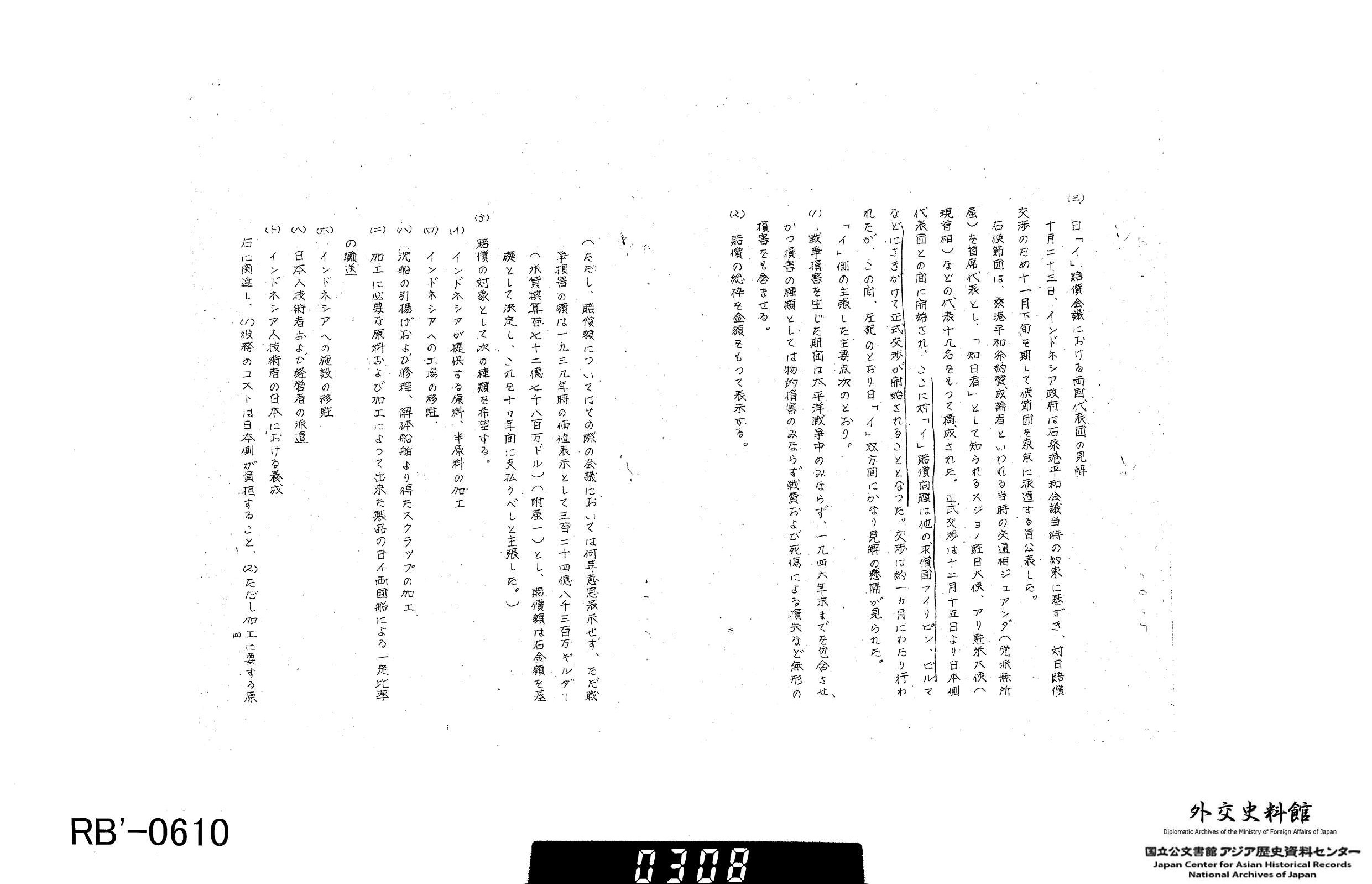
The first reparations negotiations based on the Treaty of San Francisco began in December 1951 were those held with an Indonesian delegation that visited Japan. [Document 14] consists of the cover page and opening section of a report summarizing the history of the reparations negotiations with Indonesia as of 1955. There were significant differences in opinion at the outset, but an agreement was reached in 1958.
◆Original signed copies of the treaty and agreement with Burma
[Document 15] Item: “Treaty of Peace between Japan and the Union of Burma / Signed Copy” B21010398800 (Images 1 and 5)
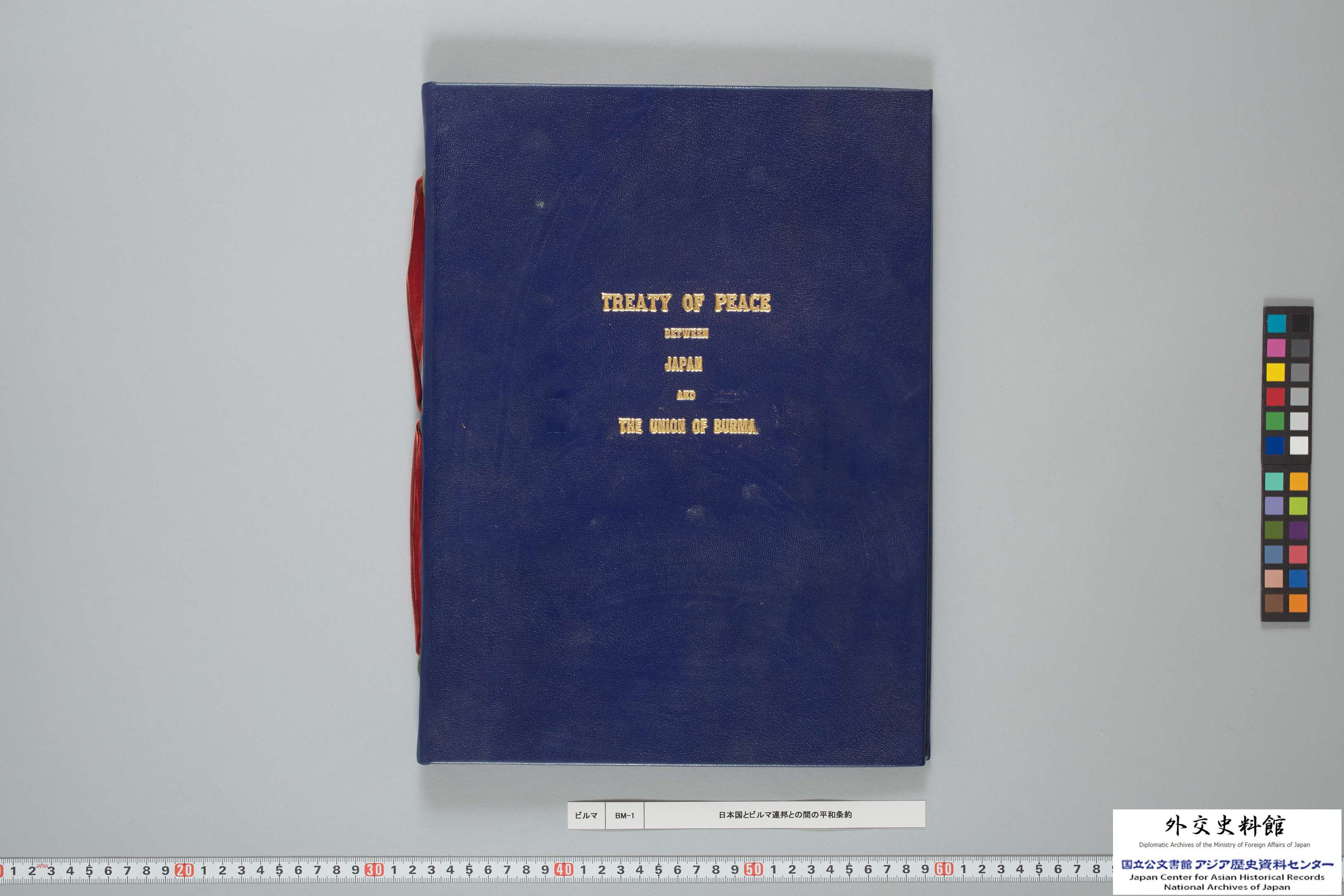
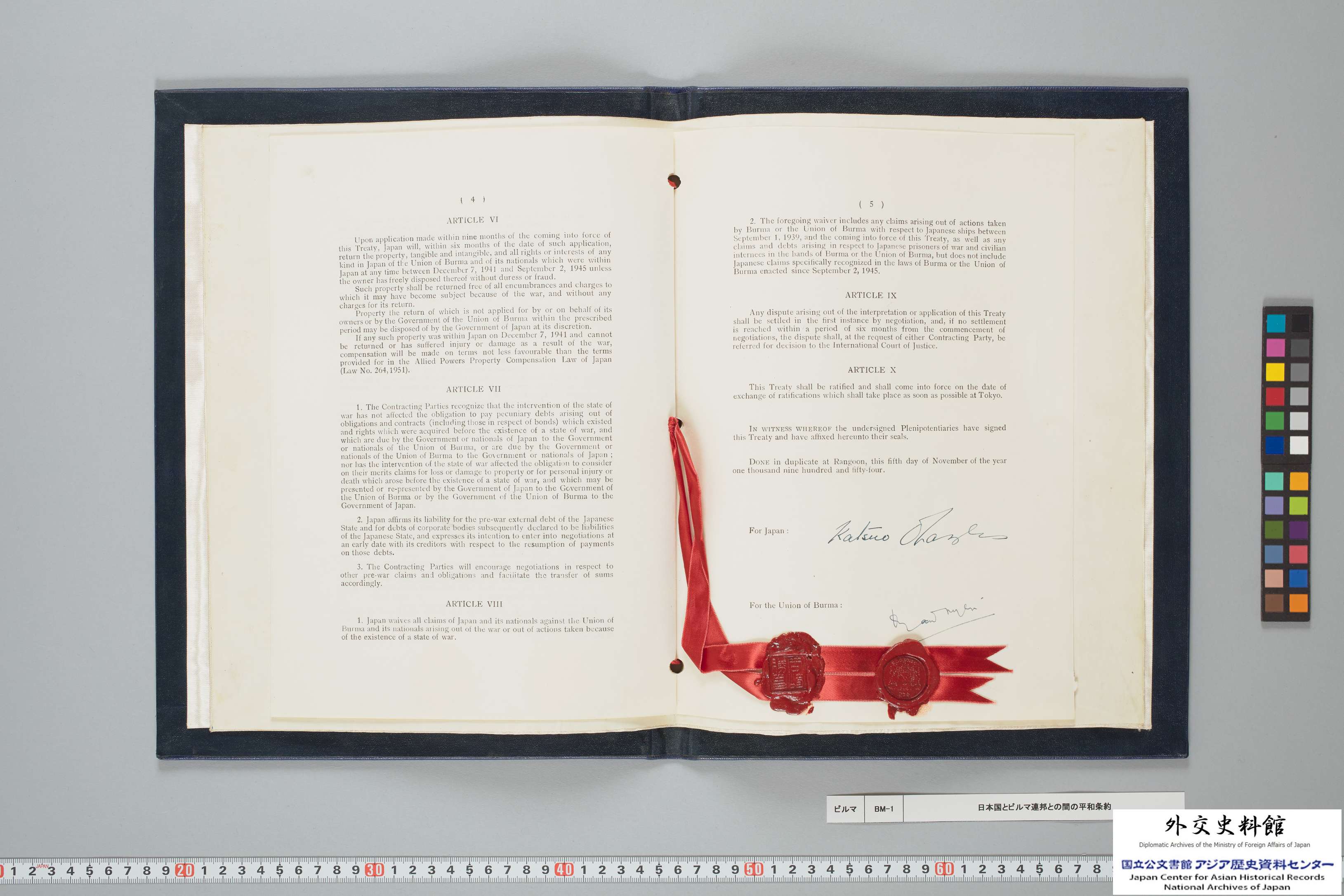
[Document 16] Item: “Agreement for Reparations and Economic Cooperation between Japan and the Union of Burma / Signed Copy” B21010401200 (Images 1 and 4)
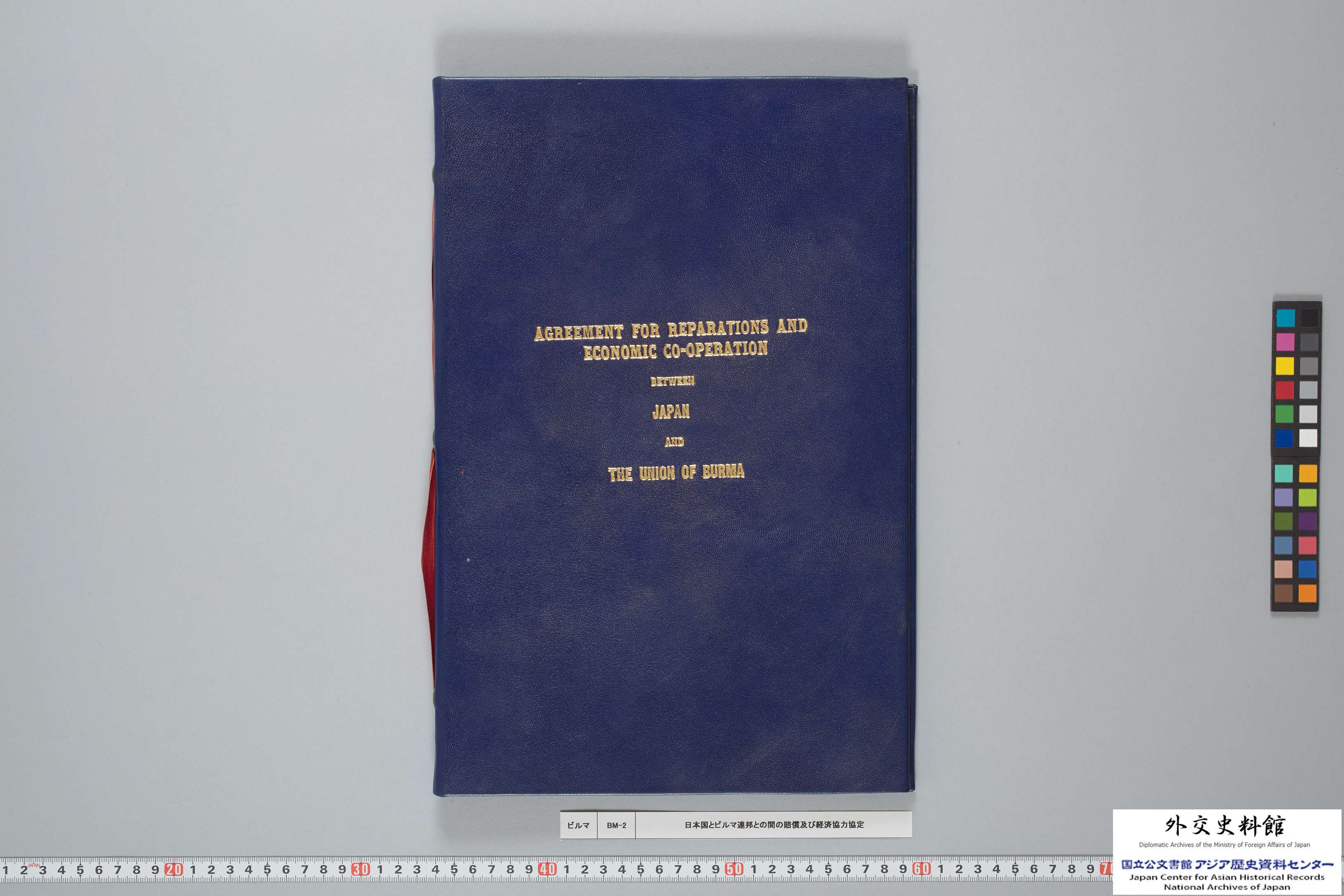
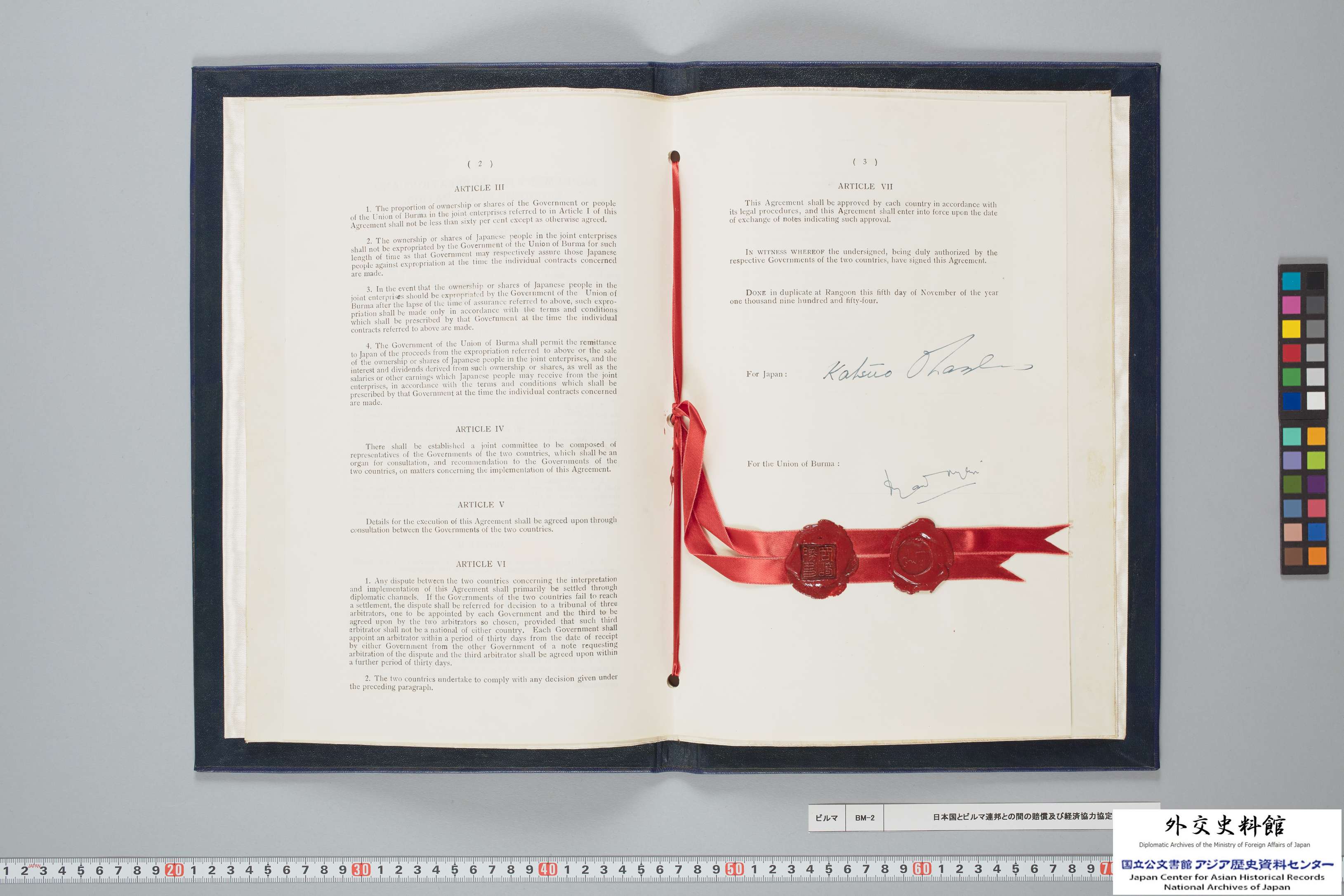
[Document 15] and [Document 16] are the original copies of the peace treaty and the agreement on reparations and economic cooperation that Japan concluded with Burma in 1954. The Japanese text can be found in this record (B24010090300). While negotiations on the reparations agreement proceeded in parallel with those connected to various other Asian countries, Burma was the first to reach a settlement.
◆Top-Secret Telegram Conveying Laos’s Intention to Waive Its Right to Reparations
[Document 17] Item: “(4) Laos” B24010108800 (Images 7–8)
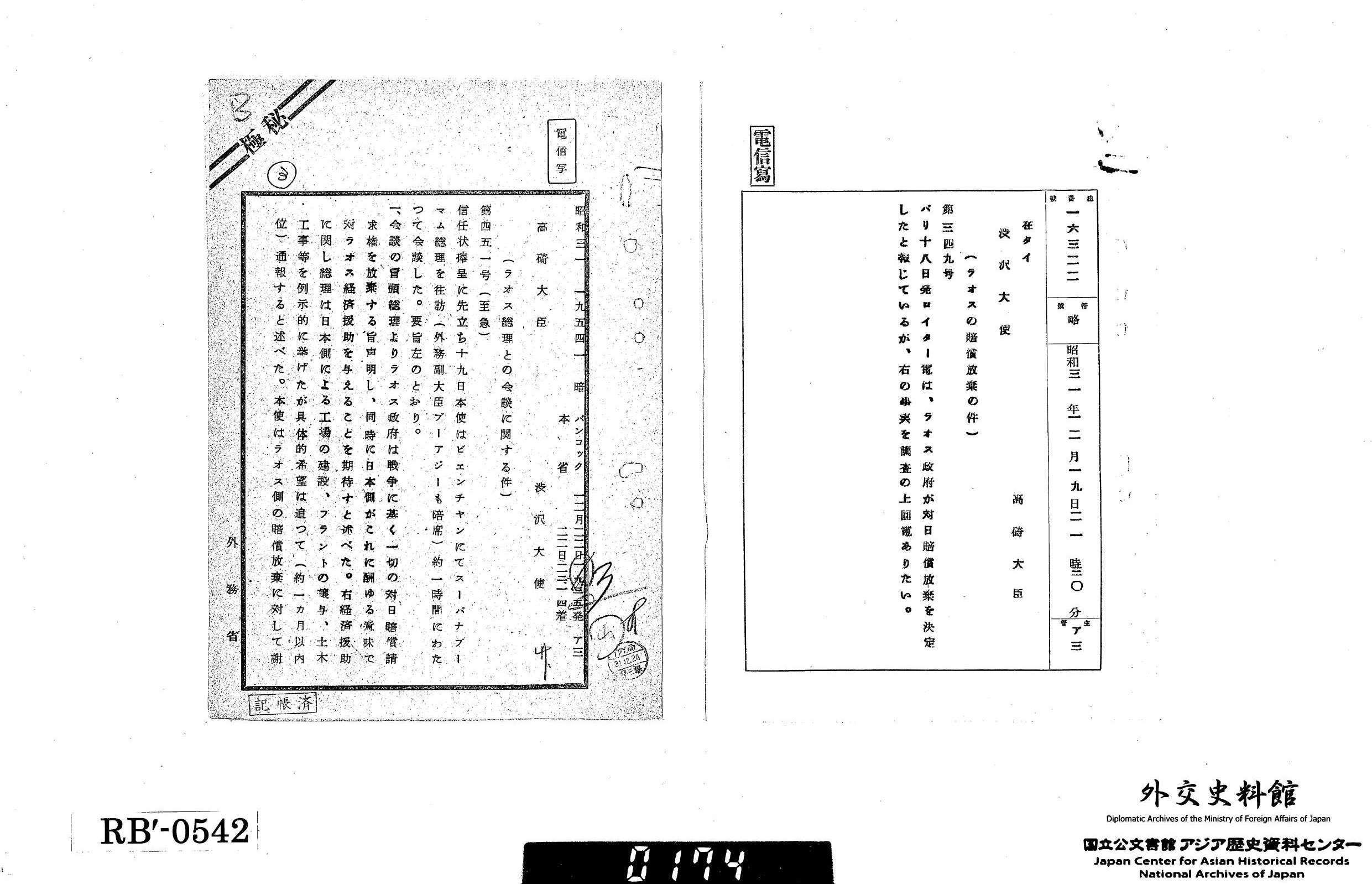
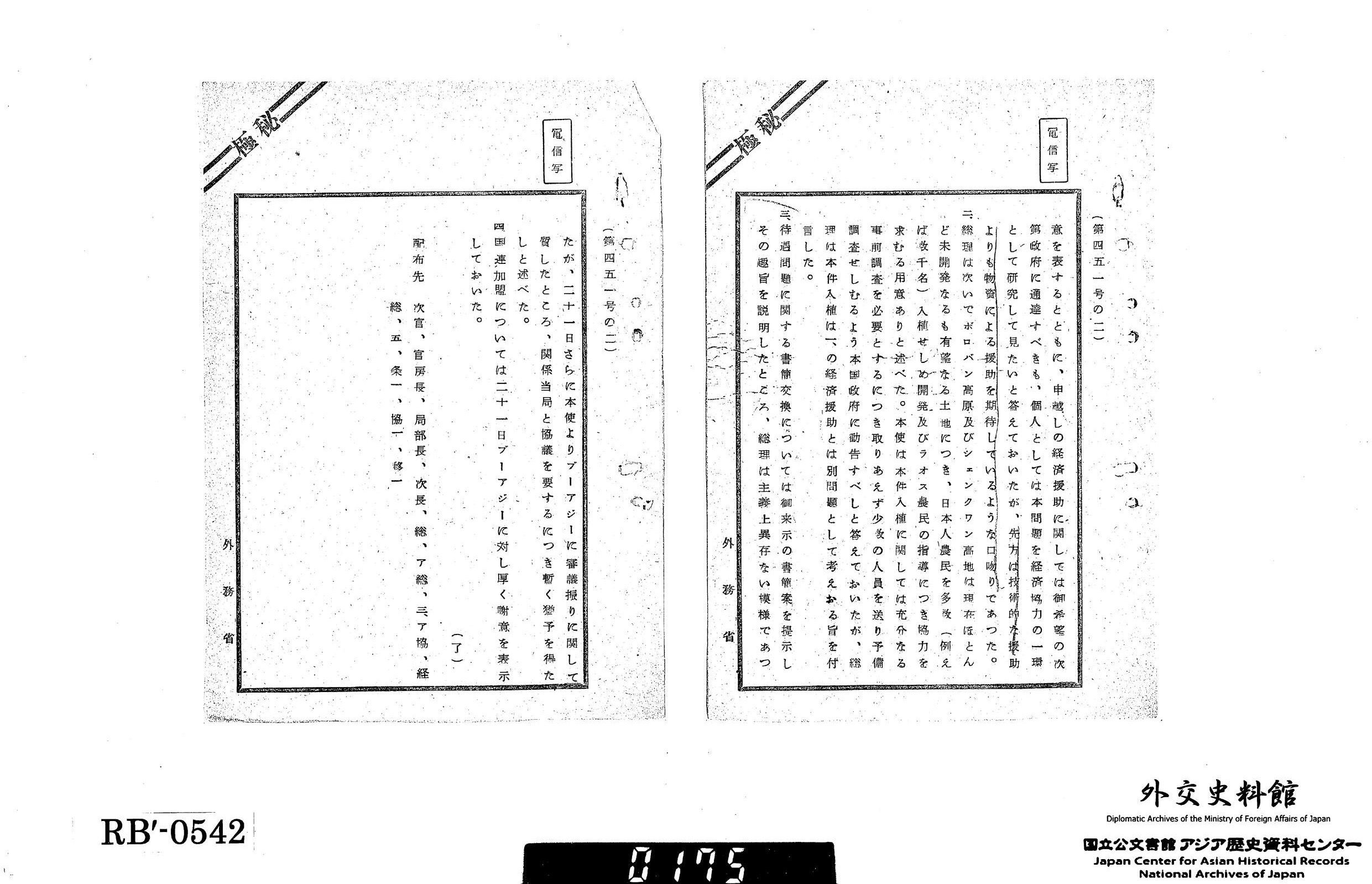
In urgent cases, correspondence between MOFA and overseas diplomatic missions is conducted via telegram. [Document 17] is a copy of a telegram sent in 1956 to Acting Foreign Minister Takasaki by Ambassador Shibusawa, who was stationed in Thailand and had met with the prime minister of Laos. The telegram reports that the Laotian prime minister stated he would waive Laos’s right to claim reparations from Japan and expressed hope for economic aid. The communication was classified as “Top Secret” and “Urgent.”
◆Report on Philippine Newspaper Editorials Regarding the Reparations Agreement
[Document 18] Item: “Matter Concerning Japan-Philippines Reparations Negotiations: Newspaper Editorial Coverage, Vol. 6” B24091104700 (Image 76)
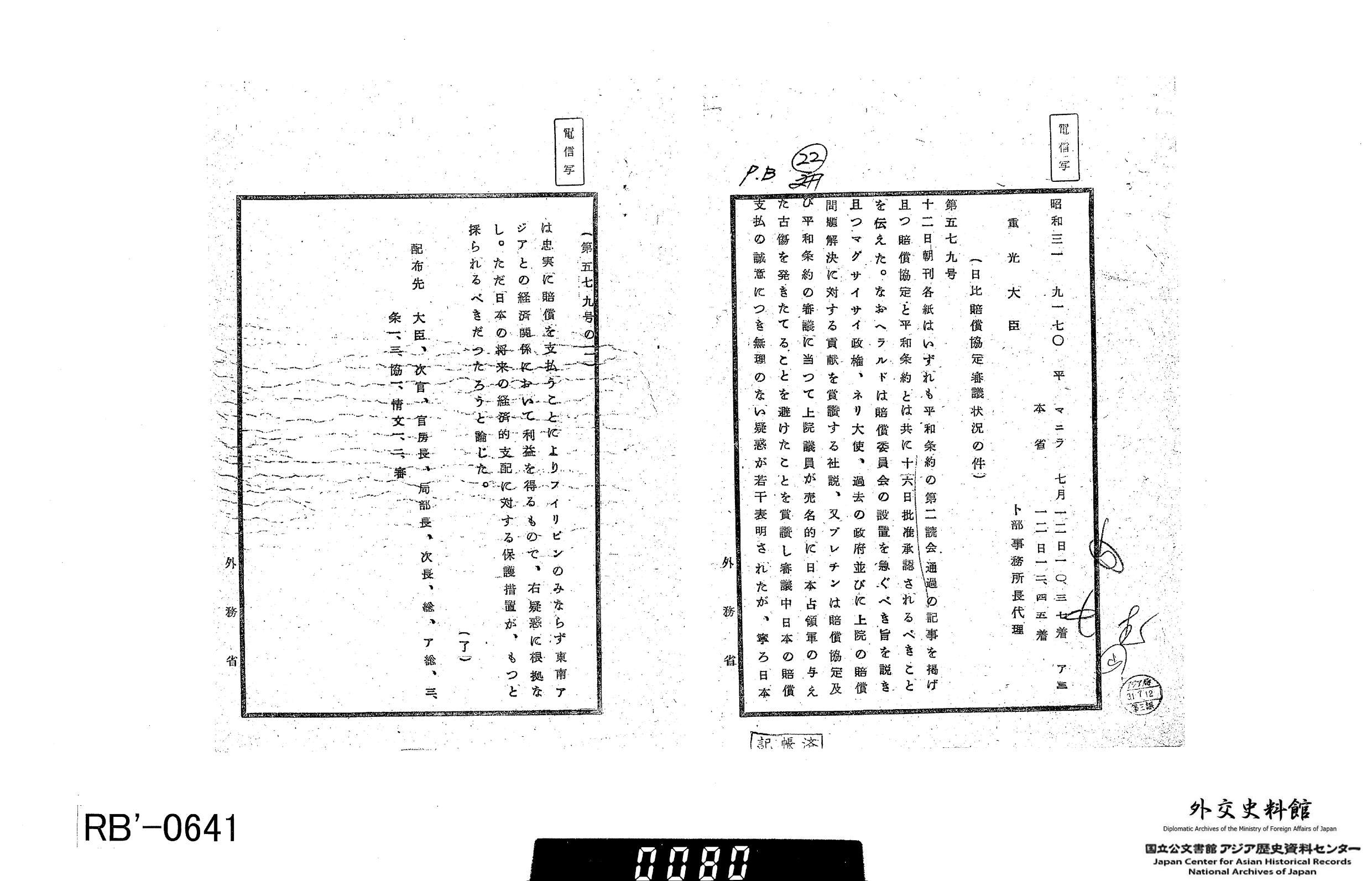
[Document 18] is a copy of a telegram reporting on the coverage by various Philippine newspapers of the Philippine Senate’s deliberations regarding the reparations agreement between Japan and the Philippines. It was sent from the Japanese Government Overseas Office in Manila to MOFA back in Tokyo. Articles from the morning edition of July 12, 1956 had reached MOFA by early afternoon that same day and appear to have been distributed to the foreign minister, the vice minister, and other relevant offices.
◆Photographs of the Agreement Signing Ceremony with South Vietnam and the Program for the Exchange of Instruments of Ratification
[Document 19] Item: “5. Negotiation Process since January 1958, Continued (Settlement of Negotiations and Conclusion of Reparation Agreements): Division 2” B24010136900 (Images 65 and 87)
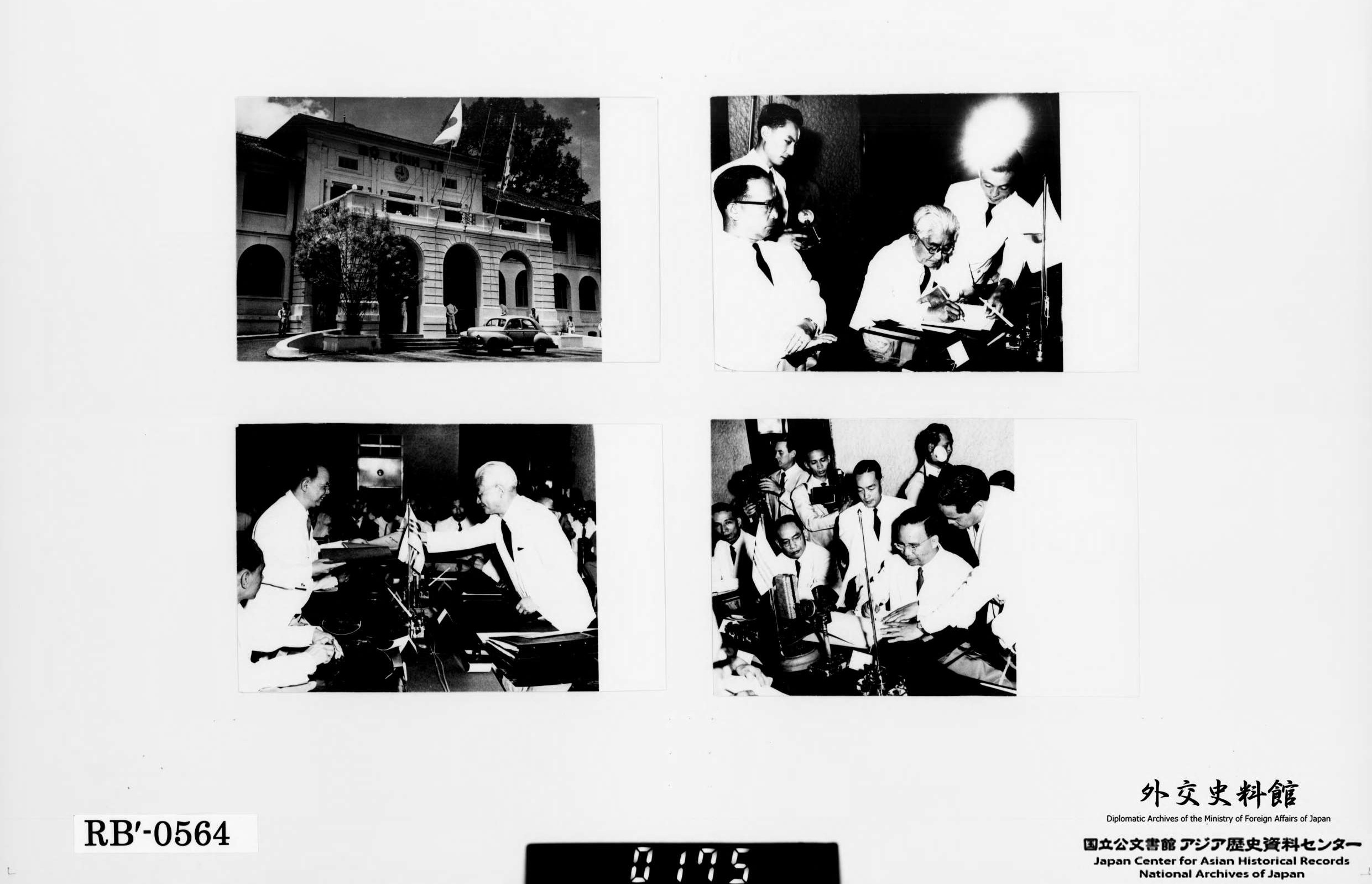
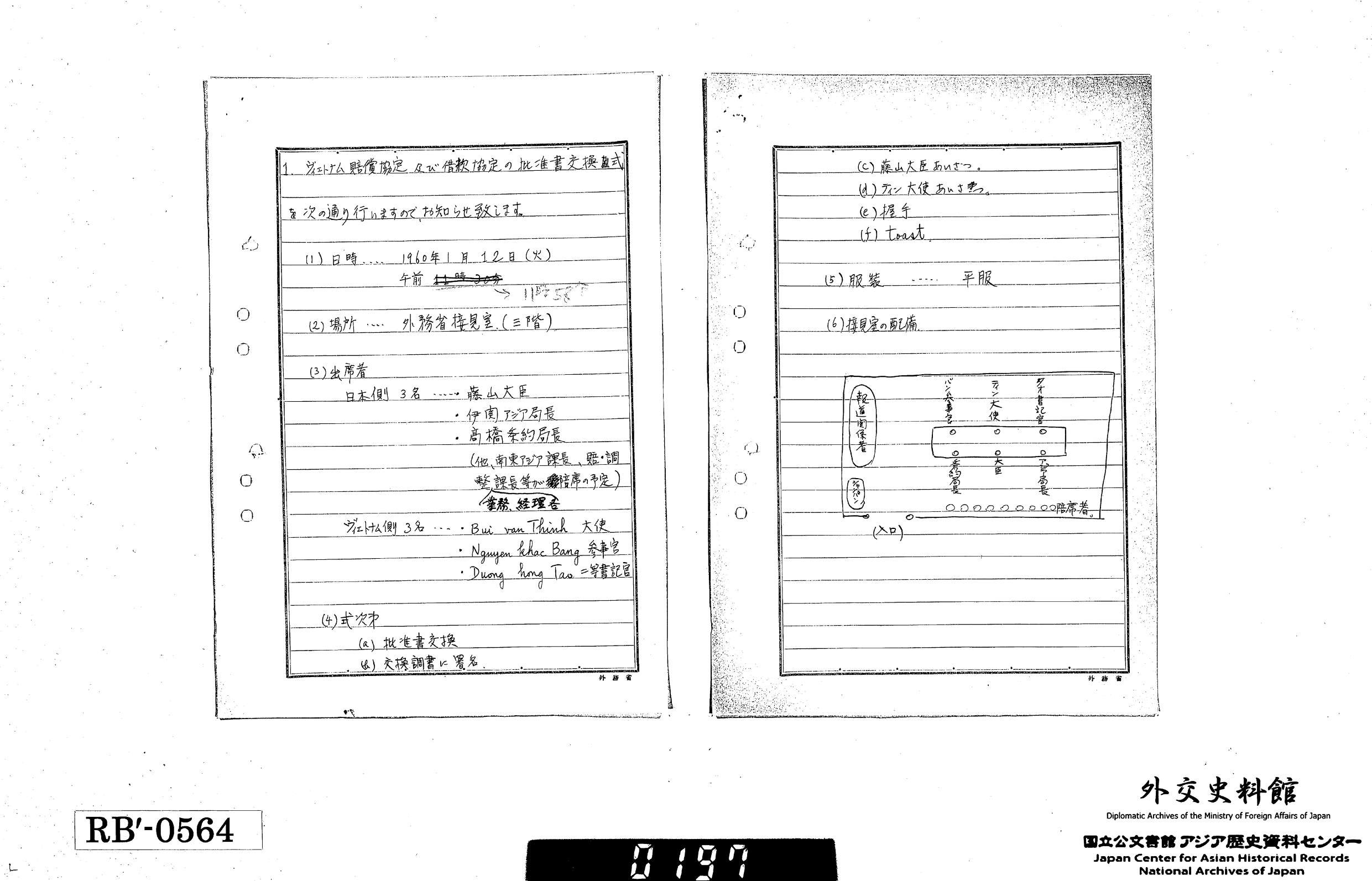
[Document 19] contains photographs of the signing ceremony for the reparations and loan agreements with South Vietnam (May 1959 [Shōwa 34]). The attendee from Japan was Foreign Minister Fujiyama. The document on the right is the program for the ceremony for exchanging the instrument of ratification (January 12, 1960 [Shōwa 35]). Documents detailing the procedures for such ceremonies also remain.
Please refer to (B21010420200) for the signed text of the reparations agreement and (B21010422200) for the signed text of the loan agreement.
◆The Road to the Normalization of Japan-South Korea Diplomatic Relations
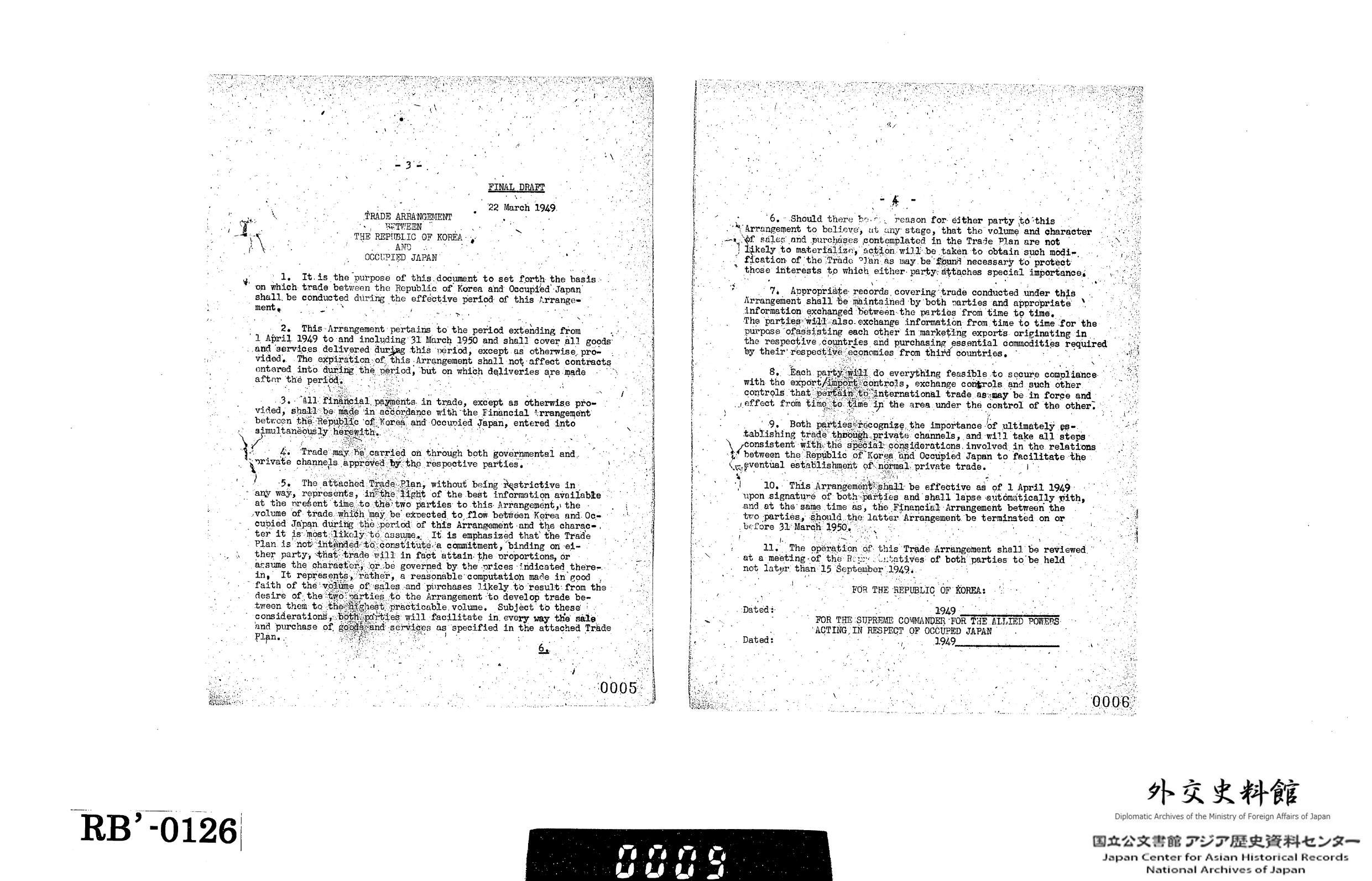
[Document 20] Item: “1. Japan-Korea trade finance agreement of April, 1949, and minutes of the meeting (in English) (March 10 - March 22, 1949)” B19010203100 (Images 2–3)
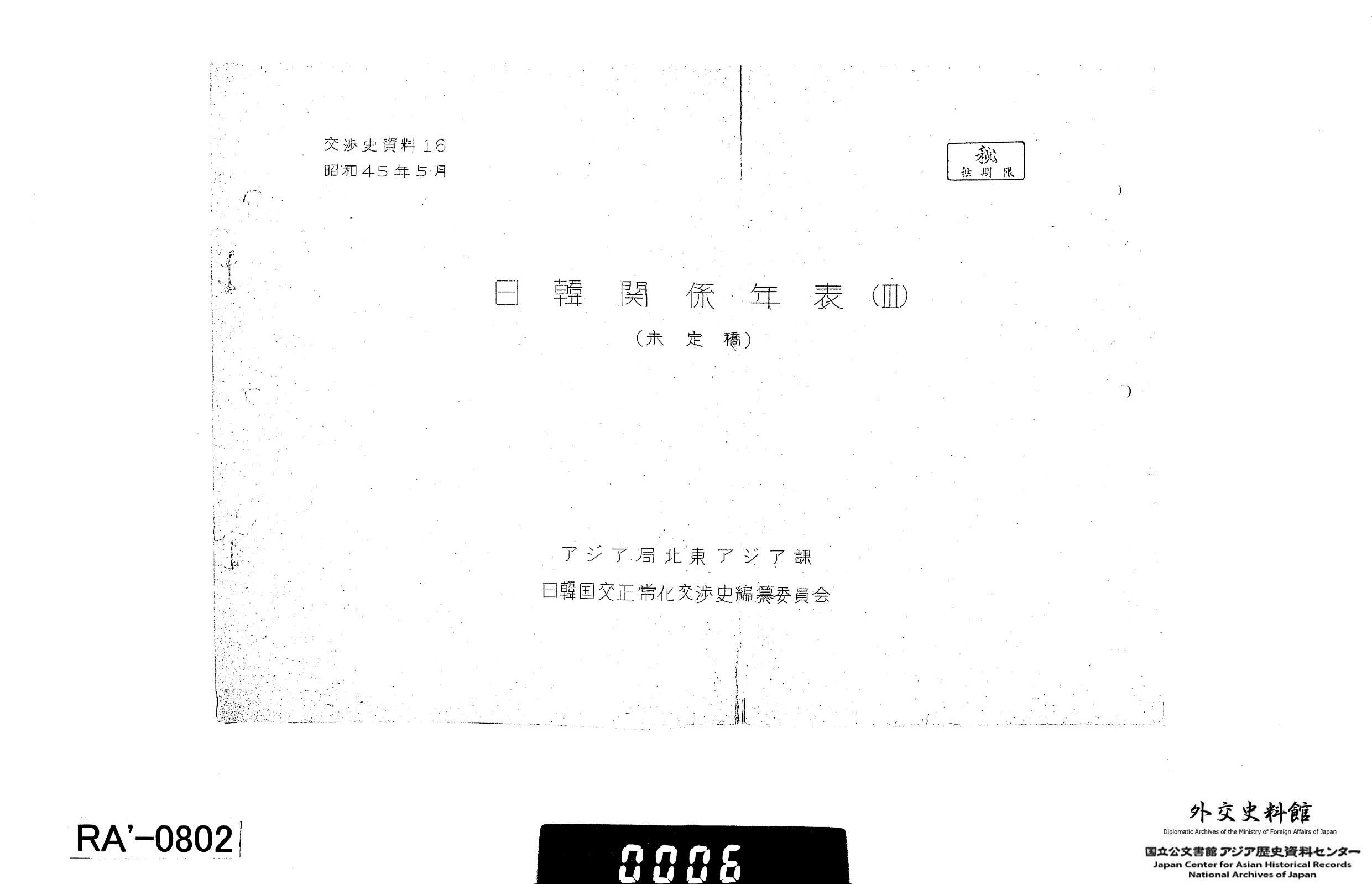
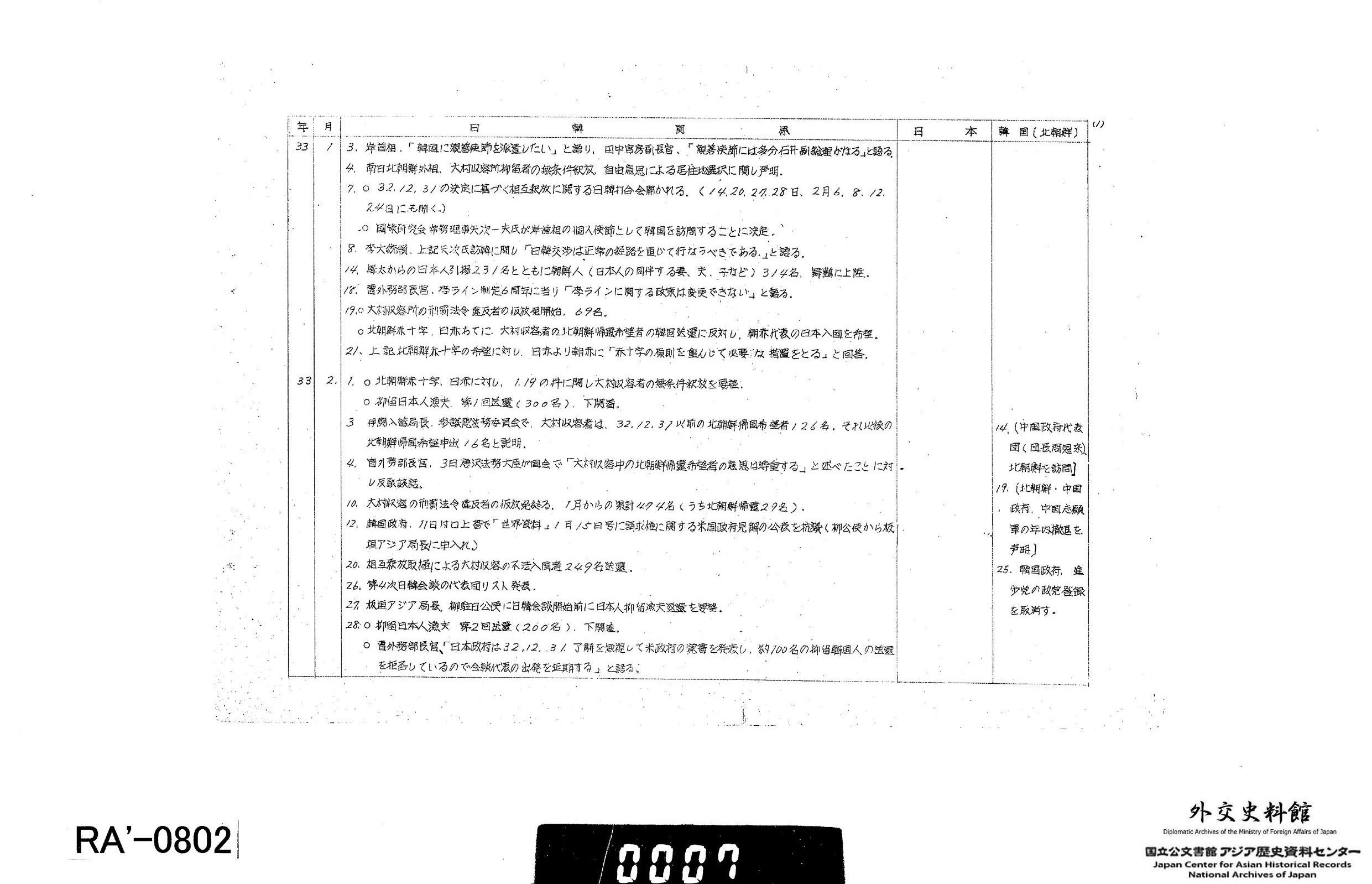
[Document 21] Item: “Diplomatic Relations between Japan and South Korea: History of Negotiations for the Normalization of Japan-South Korea Relations—‘Documents on the History of the Negotiations,’ Vol. 2” B25090829300 (Images 2–3)
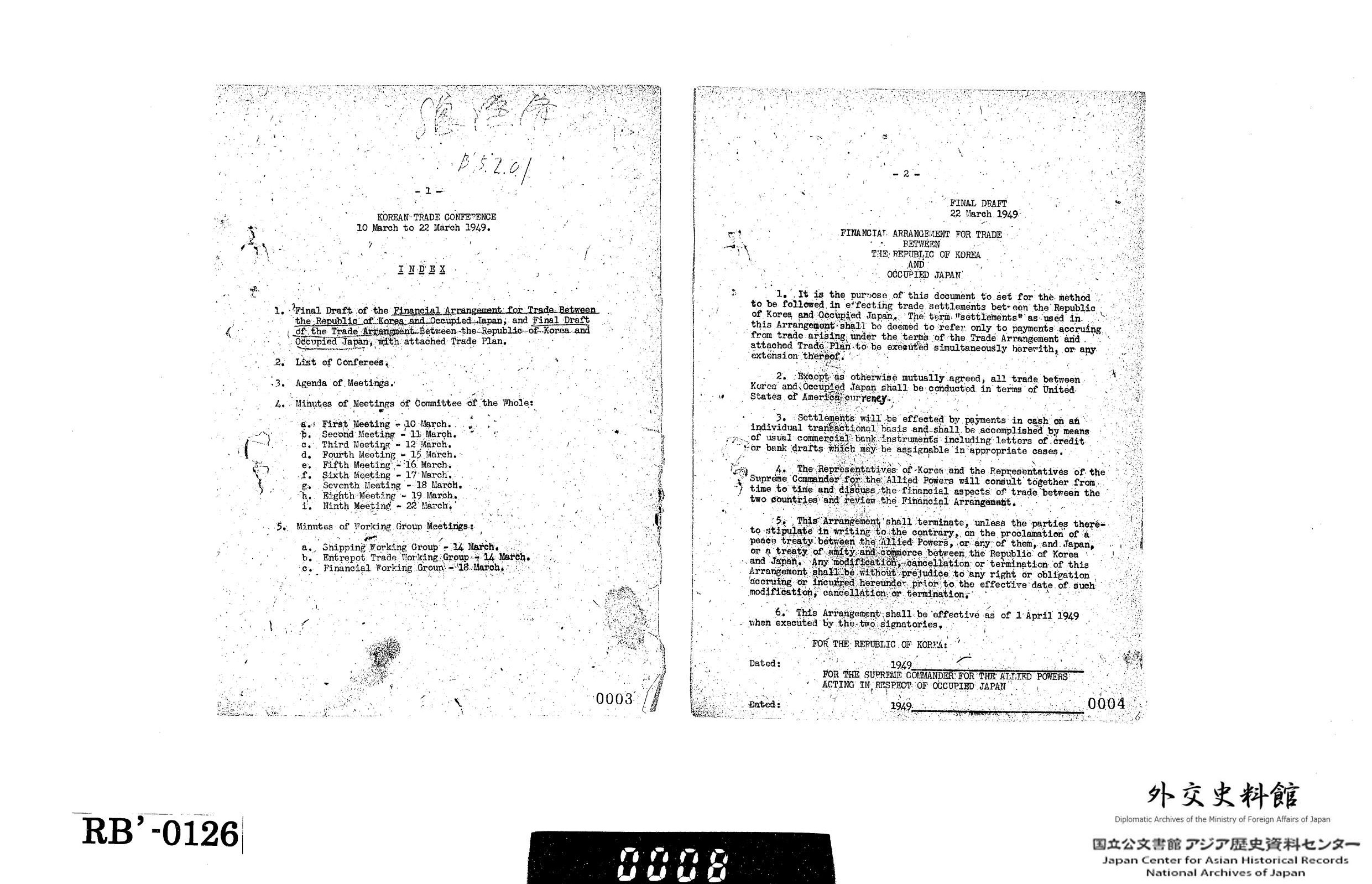
Turning next to South Korea, the Korean Diplomatic Mission in Japan was established in Tokyo in January 1949 while Japan was under occupation. As a result of trade talks held in March of that year between the SCAP and South Korea, the “Financial Arrangement for Trade between the Republic of Korea and Occupied Japan”and the “Trade Arrangement between the Republic of Korea and Occupied Japan” were finalized and signed on April 23 (Nihon gaikōshi [A history of Japanese diplomacy], Vol. 28). [Document 20] is the minutes of the March 22 talks (in English) and includes the texts of both arrangements. Bearing the burden of the occupation of both countries, the United States is said to have also exerted strong pressure to restore economic relations between Japan and Korea (Sengo Nikkan kankeishi [A history of postwar Japan-Korea relations]).
Negotiations toward the normalization of Japan-South Korea relations began the month after the San Francisco Peace Treaty was signed. These eventually led to the signing in 1965 of the Treaty on Basic Relations between the Republic of Korea and Japan, along with agreements on claims and on economic cooperation. Subsequently, efforts began at MOFA in 1967 to compile a history of the negotiations between South Korea and Japan. The following year, the Committee for Compiling the History of Negotiations on the Normalization of Japan-Republic of Korea Relations was established to carry out the work. [Document 21] is one of the chronologies created during that process (another document [Ref: B25090829000], also compiled by the same committee, is available on the JACAR website). The committee’s general remarks and diplomatic records regarding these normalization negotiations are not currently available through JACAR.
◆The “LT Trade” Memorandum with the People’s Republic of China
[Document 22] Item: “(3) Memorandum” B24010241800 (Image 2)
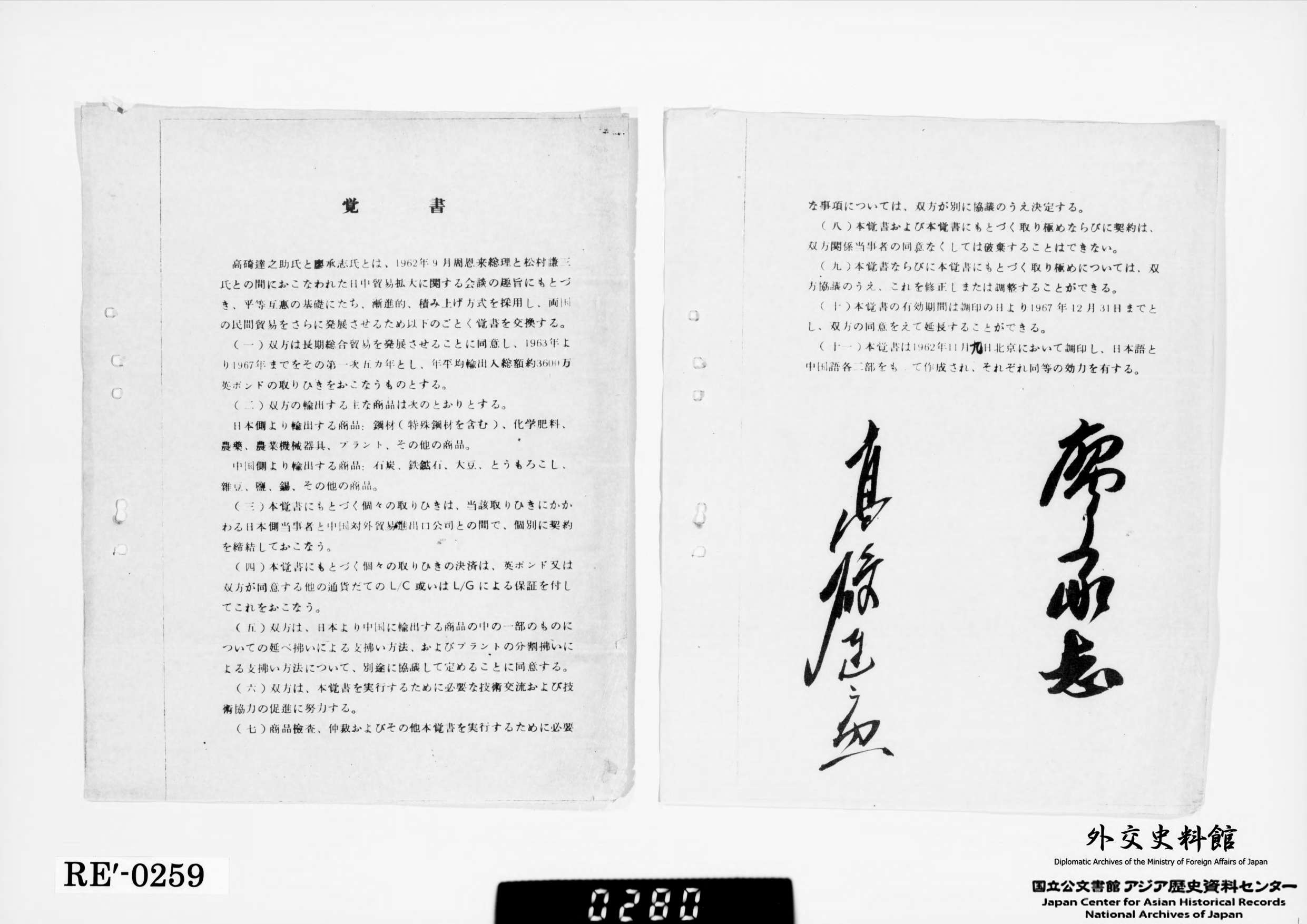
There was a period when trade between China and Japan was temporarily suspended, but it resumed in the 1960s. The Ikeda Hayato Cabinet sought to expand Japan-China trade, and with its support the “Memorandum Concerning Sino-Japanese Long-Term Comprehensive Trade” was signed in November 1962 [Document 22]. Trade conducted under this memorandum is referred to as “LT Trade,” a term derived from the initials of the signatories, Liao Chengzhi (a Chinese politician and later president of the China-Japan Friendship Association) and Takasaki Tatsunosuke (a member of the House of Representatives and former Minister of International Trade and Industry). Because it was signed by individuals positioned close to the government and involved the establishment of liaison offices on both sides, it has also been described as “quasi-governmental trade.” It marked a new step forward in the development of economic exchanges between Japan and China.
