JACAR Newsletter
JACAR Newsletter


JACAR Newsletter Number 49
March 31, 2026
Overseas Activity Report
Overseas Activity Report
A Trip to Korea for Information and Scholarly Exchange
(Attendees: Mr. Araki, Deputy Director-General, Asia Historical Materials Center, and Mr. Asakura, Researcher)
Attendance at the General Assembly and Seminars of the East Asian Regional Branch of the International Council on Archives (EASTICA)
(Location: Busan, South Korea / Tuesday, November 11, 2025 – Wednesday, November 12, 2025)
EASTICA was established in 1993 by the International Council on Archives (ICA) to serve as its organizational presence in East Asia. Bringing together archives and experts from Japan, South Korea, China, Hong Kong, Macau, Mongolia, and North Korea, it aims to strengthen cooperation among regional archivists and promote the preservation and protection of archives. Key activities include holding General Assemblies and seminars, conducting specialized training programs for Postgraduate Certificates in Archival Studies (PCAS) and Postgraduate Diplomas in Archival Studies (PDAS), fostering international cooperation, managing the website, and publishing an annual journal.
On this occasion, we participated in the General Assembly held in Busan, South Korea. The theme of the General Assembly was AI technology. Initiatives to make use of AI-powered tools by archives in South Korea, China, Hong Kong, Macau, Mongolia, Malaysia, and Vietnam and challenges arising from them were shared. While the need for metadata development to achieve advanced search systems and enthusiasm for actively utilizing AI technology is growing across countries, the common challenge identified was that human oversight regarding AI-generated misinformation (so-called “hallucinations”) remains essential.
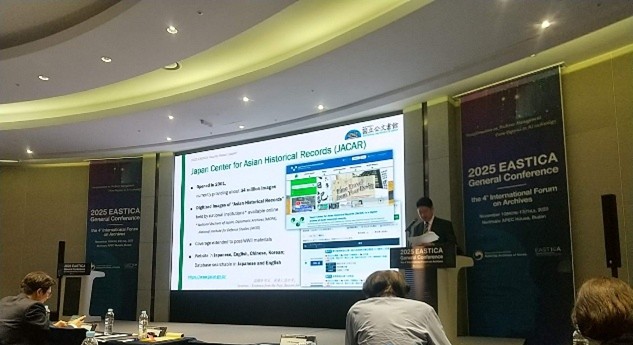
(A presentation at the EASTICA General Assembly)
At working meetings over lunch and dinner, as well as during breaks between scheduled events, we distributed materials on JACAR to representatives from participating countries (South Korea, China, Hong Kong, Macau, Mongolia, Malaysia, Vietnam) and to EASTICA Secretary-General Lee Sang-min, and asked them to consider making use of what JACAR has to offer. Secretary-General Lee Sang-min mentioned that in South Korea, there is significant interest in historical materials produced by the Japanese Government-General of Korea, dating from the colonial era.
Exchange of Views with Staff of the National Archives of Korea
(Location: Seoul, South Korea / Thursday, November 13, 2025)
We traveled to Seoul and held discussions with Ms. Park, a senior archivist at the National Archives of Korea. We heard about the current state of progress in digitization, OCR processing, and AI utilization for the archives’ holdings. We learned about their advanced initiatives, including the fact that OCR processing of materials has been underway for about five years and that AI utilization is being promoted as a national initiative.
Exchange of Views with Korean Scholars of Japanese Studies
(Location: Seoul, South Korea / November 13 (Thu) – 14 (Fri), 2025)
We met with Chang Soo Jin, Senior Research Fellow of the Center for Japanese Studies at the Sejong Institute, Professor Kim, Assistant Professor Lee, Research Professor Ko, and Research Professor Hyun from Inha University, and Professor Park from Seoul National University to exchange views on the current state of Japanese studies in South Korea.
Some of these attendees shared the impression that there is a decline in the number of Japanese studies scholars and students studying in Japan among South Koreans recently. Several researchers inquired about the selection policy for historical materials in the JACAR database. We explained that historical materials provided by the National Archives of Japan, the Diplomatic Archives of the Ministry of Foreign Affairs, and the National Institute for Defense Studies of the Ministry of Defense are published without selection or modification on the part of JACAR. Furthermore, since many of the researchers we met this time were learning about JACAR for the first time, it became clear to us that there is a need to improve awareness of the JACAR database overseas.
Exchange of Views with the Korean Ministry of Foreign Affairs Official in Charge of Historical Issues
(Location: Seoul, South Korea / Friday, November 14, 2025)
We met with Ms. Oh Jin-hee, Deputy Director-General of the Asian and Pacific Affairs Bureau at the Korean Ministry of Foreign Affairs, and explained the background of the establishment of JACAR, emphasizing that one of its foundational objectives was to make accessible official documents related to modern and contemporary history between Japan and its neighboring Asian countries. Ms. Oh mentioned that she understood that the establishment was prompted by former Prime Minister Murayama. In response, we explained that JACAR was established in 2001 based on the Peace and Friendship Exchange Plan announced by former Prime Minister Murayama, with the expressed goal of promoting mutual understanding between Japan and the various countries of Asia through the sharing historical facts.
Summary
Through the series of meetings and exchanges of opinions held in Busan and Seoul, we came away with a renewed understanding of the necessity and importance of exploring how to utilize AI technologies effectively in a digital society, in order to provide materials to a wide range of users both in Japan and abroad. We also realized anew that it is necessary to strengthen JACAR’s public relations and outreach both domestically and internationally.
ASAKURA Shinnosuke, Researcher
Japan Center for Asian Historical Records (JACAR)