JACAR Newsletter
JACAR Newsletter


JACAR Newsletter Number 49
March 31, 2026
Special Feature
Introducing the “Postwar Diplomatic Records” Provided by the Ministry of Foreign Affairs (2)
Sumio Hatano
Director-General, Japan Center for Asian Historical Records
Abstract
This article introduces postwar diplomatic records provided by the Ministry of Foreign Affairs to the Japan Center for Asian Historical Records (JACAR). Focusing on major themes such as Japan’s recovery of sovereignty, the reconstruction of relations with Asian countries, accession to the United Nations, and the development of Japan–U.S. relations, it highlights selected archival materials that illuminate the course of Japan’s postwar diplomacy.
Introduction
Since fiscal year 2016, the Diplomatic Archives of the Ministry of Foreign Affairs (MOFA) has been providing publicly available “Postwar Diplomatic Records” to the Japan Center for Asian Historical Records (JACAR), broadly in chronological order. The appended table presents an overview of the postwar records provided as of the end of 2024. The materials are organized according to the alphabetical classification numbers (A′–M′) used by the Diplomatic Archives and grouped into broad subject categories (“sections”). The list also includes record groups newly added since the previous introduction.
At present, the postwar records available through JACAR extend to the early 1970s. While Japan continued to confront issues related to the “postwar settlement” of the Pacific War, the country emerged from the long Occupation period and regained its independence. The central themes of the era included the reconstruction and stabilization of relations with the United States, the rebuilding of diplomatic relations with Asian countries, and Japan’s return to the international community.
In JACAR Newsletter No. 45 (December 2024), the first installment of this series introduced records corresponding to Section 1 (Acceptance of the Potsdam Declaration) through Section 3 (Communications Concerning the Termination of the War). These materials concerned the end of the war, repatriation, and certain aspects of the Allied occupation of the Japanese home islands.
In the present installment, I introduce a selection of records beginning with Section 4 (General Diplomatic Policy of Japan) from the perspective of the history of Japan’s postwar diplomacy. I also briefly supplement the previous article by introducing several important cases within Sections 1–4 that could not be discussed earlier.
In the previous table, the section numbers were indicated in Roman numerals; in the present article they are expressed using Arabic numerals.
In introducing major cases, reference is also made to the documentary series “Documents on Japanese Foreign Policy” (hereafter referred to simply as “Documents”). The postwar volumes of this series are compiled and published on the basis of those postwar diplomatic records that can be made publicly available by the Diplomatic Archives. For each relatively coherent diplomatic issue, important documents are selected and systematically edited, making the series a convenient resource for understanding the development and overall outline of major diplomatic questions.
The following volumes are particularly relevant:
①The Era of Occupation (3 vols.)
②The Era of Occupation: Related Reference Documents
③Reference Materials Concerning the Conclusion of the Peace Treaty (5 vols.)
④The San Francisco Peace Treaty (3 vols.)
⑤The Treaty of Peace between Japan and the Republic of China
⑥Reparations Negotiations Following the Conclusion of the San Francisco Peace Treaty (2 vols.)
➆Reparations Negotiations Following the Conclusion of the San Francisco Peace Treaty: Reference Materials
⑧Japan’s Admission to the United Nations
⑨Japan’s Accession to the GATT
⑩The Reversion of Okinawa, Vol. 1
⑪The Shōwa Era, Series IV: Japan–U.S. Relations, Vol. 1 (1952–1954)
Items 1–10 follow a thematic compilation format, focusing on specific diplomatic issues. Item 11 follows a chronological format, presenting documents related to major bilateral relations—in the postwar period, particularly Japan–U.S. relations—over a defined period. A second volume covering Japan–U.S. relations from 1955 to 1960 is planned.
- From Occupation to Independence
(1) The Era of Occupation
Revision of the Imperial Constitution (Enactment of the New Constitution)
It is well known that the Constitution of Japan (promulgated in November 1946) was enacted through the amendment procedures of the Constitution of the Empire of Japan (the Meiji Constitution). The documents provided under the title “Materials Concerning the Revision of the Imperial Constitution” do not reveal the full details of the amendment process, but they clearly show how MOFA approached the issue.
Immediately after the end of the war, MOFA anticipated that the Imperial Constitution would be revised and began conducting its own investigations and research. The records include proposals for constitutional reform prepared within MOFA, files of correspondence exchanged between the General Headquarters (GHQ) of the Supreme Commander for Allied Powers and the Japanese government (through the Central Liaison Office), Minister of State Matsumoto Jōji’s “Private Draft for Constitutional Revision,” and a letter sent by Shirasu Jirō—advisor to the Central Liaison Office—to the Civil Affairs Section of GHQ.
Among these documents, the Shirasu letter is particularly well known as the “Jeepway Letter.” In it, Shirasu illustrated—by means of a diagram—that Japan’s constitutional design should follow a “path consistent with national conditions,” which he metaphorically described as a “jeepway.”
/分割1B17070081300.jpg)
「(no title) / Partition 1」JACAR(Japan Center for Asian Historical Records)Ref.B17070081300、A matter related to the revision of Imperial Constitution / Constitutional amendment draft outline(A’.3.0.0.2-1)(Diplomatic Archives of the Ministry of Foreign Affairs), image 76
MOFA was also deeply concerned about the future of the imperial institution. It therefore commissioned lectures and essays from leading scholars—including constitutional scholar Miyazawa Toshiyoshi and political scientist Takagi Yasaka—seeking arguments in support of the imperial system from various perspectives in law, philosophy, political science, and history. The resulting compilation, “Studies on the Imperial System,” is of considerable interest.
Its contents are introduced in Chapter 4 of the online exhibition “The Withering Empire of Japan,” part of JACAR’s special internet exhibition marking the 80th anniversary of the end of the war.
In addition, “The Era of Occupation (Vol. 3)” includes major Ministry of Foreign Affairs documents related to the drafting of the Constitution.
(2) Interim Reparations
“Interim reparations” refers to the Allied powers’ initial plan for Japanese war reparations. Edwin W. Pauley, the U.S. ambassador responsible for the Japanese reparations issue following his work on German reparations, announced in December 1945 that the purpose of reparations from Japan was to prevent the resurgence of militarism while promoting economic stability and democratic development.
Specifically, the plan called for the removal of plants and equipment—such as those used for aircraft manufacturing, steel production, machine tools, and shipbuilding—as reparations. Where possible, these facilities were to be transferred to Asian countries that had suffered wartime damage to assist in their reconstruction.
In May 1946 the Pauley plan was adopted by the Far Eastern Commission as the Interim Reparations Program, thereby becoming official Allied policy. In the same year more than 500 factories across various industrial sectors were designated for reparations, and Japan was obliged to dismantle these plants and equipment and prepare them for shipment abroad.
Pauley’s final report, published in November 1946, proposed even higher levels of removals. A distinctive feature of the report was that it did not include reparations paid in the form of newly produced goods.
In January 1948 a Chinese vessel departed Yokosuka for Shanghai carrying machine tools—the first shipment of reparations materials. Subsequently, however, the recommendations of the Strike Mission and the Johnston Mission led the United States to adopt a policy of easing the removal program.
In May 1949 a statement by William J. McCoy, the U.S. representative to the Far Eastern Commission, brought the interim reparations program to an end. McCoy explained that further removals would hinder the occupation’s objective of stabilizing and making the Japanese economy self-sustaining.
Section 29 of the archival records includes the Pauley Report and related materials documenting the evolution and implementation of Allied reparations policy during the occupation.
」-scaled.png)
「 Ambassador Pauley’s statement (December 7, 1945)」JACAR(Japan Center for Asian Historical Records)Ref.B19010370200、Reparation of Japan under occupation / Ambassador Pauley’s visits to Japan relation(B’.3.1.1.1-3)(Diplomatic Archives of the Ministry of Foreign Affairs), image 2

「 The opinion of Ambassador Pauley about the final report on the reparation of Japan」JACAR(Japan Center for Asian Historical Records)Ref.B19010370800、Reparation of Japan under occupation / Ambassador Pauley’s visits to Japan relation(B’.3.1.1.1-3)(Diplomatic Archives of the Ministry of Foreign Affairs), image 2
Major documents concerning interim reparations are also included in The Era of Occupation (Vol. 2). In addition, “Reparations Negotiations Accompanying the Conclusion of the Peace Treaty: Reference Documents” contains several useful reports, including “The Course of the Present Reparations Issue” and “An Overview of the Development of the Japanese Reparations Problem.”
(3) The Treaty of Peace with Japan, the (original) U.S.–Japan Security Treaty, and the Issue of Rearmament
In 2001, marking the fiftieth anniversary of the signing of the Treaty of Peace with Japan (hereafter, the Peace Treaty), the Diplomatic Archives published “Documents on Japanese Foreign Policy: Reference Materials Concerning the Conclusion of the Peace Treaty” (in five volumes). This was the first postwar installment of the “Documents” series. These materials were compiled after his retirement by Nishimura Kumao, who had served as Director-General of the Treaties Bureau for approximately five years beginning in 1947. Copies were preserved at several institutions outside the Ministry of Foreign Affairs, and even prior to publication the compilation was widely known as the “Nishimura Papers.”
Separately from these “Nishimura Papers,” the Diplomatic Archives also undertook the compilation of major records relating to the Peace Treaty itself and published “The San Francisco Peace Treaty” (three volumes). Although some materials overlap with those contained in the Nishimura compilation, these volumes assemble key records covering the period from internal ministry studies beginning in the autumn of 1945 through the signing of the treaty in September 1951. The materials are organized into three stages: “Preparatory Measures,” “Negotiations with the United States,” and “Signature and Entry into Force.”
One characteristic of the peace treaty negotiations was the extent to which they were influenced by developments in both international and domestic politics. The volume on “Preparatory Measures” (Vol. 1) shows how the Japanese government’s negotiating stance gradually shifted toward achieving a “separate peace” (meaning a peace concluded with a majority of countries) amid a divided public debate between proponents of a comprehensive treaty with all nations involved and those favoring a more limited agreement, as well as in the context of the outbreak of the Korean War.
Another notable feature was that the negotiations over the Peace Treaty proceeded as “inseparable from”—in the words of Prime Minister Yoshida Shigeru—the question of Japan’s postwar security. Initially, it had been assumed that security arrangements would be incorporated into the Peace Treaty itself. However, once full-scale negotiations with the United States began, it was decided that the U.S.–Japan Security Treaty would be concluded as a separate agreement.
The security issue was also closely connected with the question of Japan’s rearmament. In talks with special envoy John Foster Dulles at the end of January 1951, Prime Minister Yoshida presented to the American side a proposal for the establishment of a “National Security Ministry” and a plan to create a “democratic army” of approximately 50,000 personnel—measures he described as initial steps in a rearmament program (see “Negotiations with the United States,” Vol. 2).
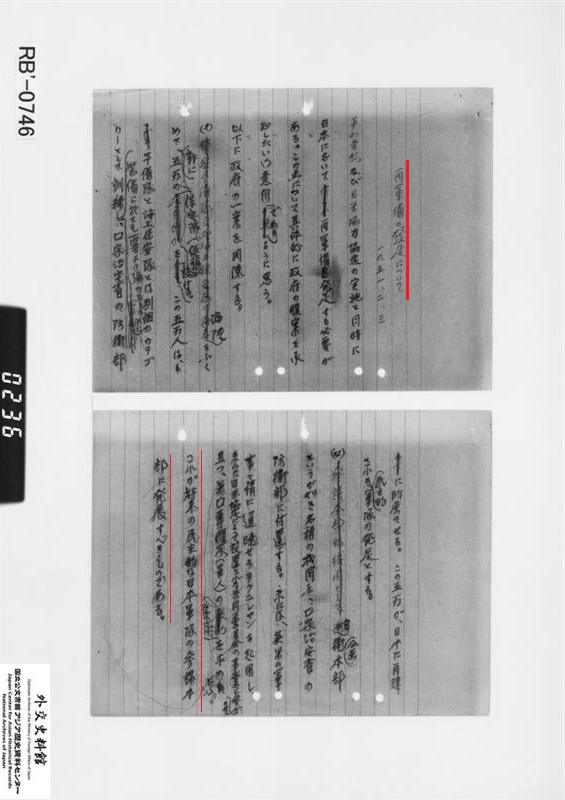
「 “Initiation of Rearmament” issued to the other party on February 3rd, 1951」JACAR(Japan Center for Asian Historical Records)Ref. B25091074800、Relations concerning the Peace Treaty with Japan: Relations concerning the First Visit of Dulles (First Negotiations), Volume 1 (B’.4.0.0.1-3_001) (Diplomatic Archives of the Ministry of Foreign Affairs), image 2
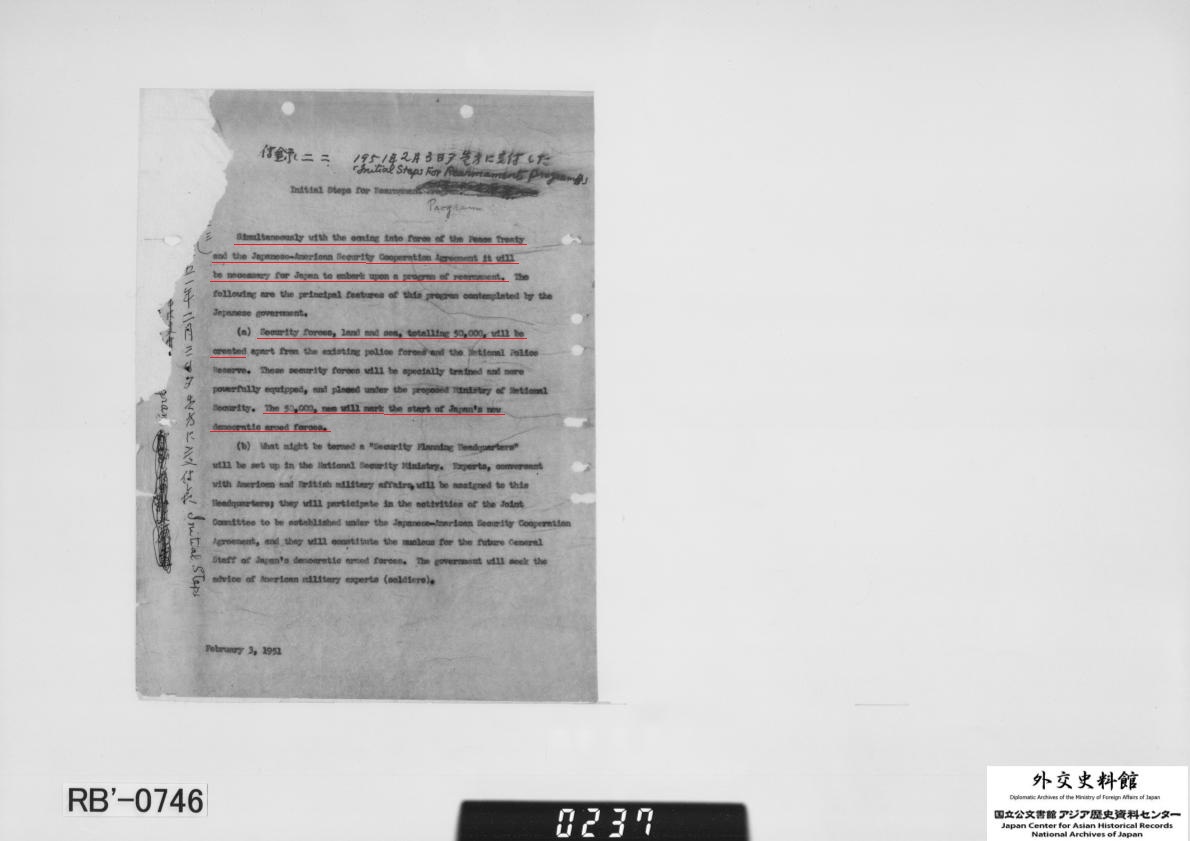
「 “Initiation of Rearmament” issued to the other party on February 3rd, 1951」JACAR(Japan Center for Asian Historical Records)Ref. B25091074800、Relations concerning the Peace Treaty with Japan: Relations concerning the First Visit of Dulles (First Negotiations), Volume 1 (B’.4.0.0.1-3_001) (Diplomatic Archives of the Ministry of Foreign Affairs), image 3
Following the signing of the Peace Treaty, negotiations were held in Tokyo from January through the end of February 1952 to conclude the U.S.–Japan Administrative Agreement, which defined the legal status of U.S. forces stationed in Japan under the Security Treaty. The volume “Signature and Entry into Force” (Vol. 3) includes materials tracing the course of these negotiations.
The Peace Treaty–related records provided in the appendix (Section 37, Category B, Class 4) contain many documents analyzing individual treaty provisions and addressing their implementation—materials not included in the published documentary collections mentioned above.
- Rebuilding Relations with Asian Countries
Following Japan’s restoration of sovereignty, rebuilding relations with Asian countries became a central task of postwar diplomacy.
(1) The Treaty of Peace between Japan and the Republic of China (Section 39)
Japan and the Republic of China government in Taiwan restored diplomatic relations in April 1952 through the conclusion of the Treaty of Peace between Japan and the Republic of China, following negotiations based on the so-called “Yoshida Letter.”
This letter, sent by Prime Minister Yoshida Shigeru to U.S. special envoy John Foster Dulles in December 1951 and made public in January 1952, confirmed that Japan was prepared to negotiate a peace settlement with the Republic of China (ROC) rather than with the People’s Republic of China (PRC) in Beijing.
In the letter Yoshida stated that Japan was prepared to restore diplomatic relations with the ROC in accordance with the principles established in the Treaty of Peace with Japan. At the same time, he specified that “the terms of such bilateral treaty shall, in respect of the Republic of China, be applicable to all territories which are now, or which may hereafter be, under the control of the National Government of the Republic of China.”
The Chinese side welcomed this statement, and negotiations began immediately. However, a discrepancy soon emerged between the two sides. Japan regarded the negotiations as intended to terminate the state of war, while the ROC government considered them negotiations for a peace treaty.
The Japanese side was concerned that the term “peace” might imply application not only to Taiwan but also to mainland China as a whole. Japan therefore insisted that the treaty’s scope of application should be limited to “territories currently under the control of the Republic of China government or which may come under its control in the future,” and sought to include this formulation in an exchange of diplomatic notes.
The Chinese side, however, proposed modifying the wording concerning the scope of application by replacing the phrase “or which may come under its control” with “and which may come under its control,” while the Japanese side insisted on retaining the original language of the Yoshida Letter. Ultimately, the original wording was maintained in the exchange of diplomatic notes, while the agreed minutes stated that the term “or” could also be understood as carrying the meaning of “and.”
Another contentious issue concerned property in Japan belonging to wartime collaborationist regimes such as Manchukuo and the Wang Jingwei government. The ROC sought recognition that these assets should be transferred to it as the legitimate government of China.
Japan refused to include such language explicitly in the minutes, arguing that the ROC government exercised authority only over Taiwan. The issue became the most difficult point in the negotiations. It was ultimately resolved through a compromise statement in the minutes to the effect that they would be revised to reflect any future agreements reached between the two countries on the matter.
The principal documents concerning these negotiations are concisely organized in the volume, “The Treaty of Peace between Japan and the Republic of China” (Section 39).
(2) Reparations to Southeast Asia — Resolution through the “Economic Cooperation” Approach
The Seven Principles for the Japanese Peace Settlement, announced by the United States in the autumn of 1951, established the principle that all Allied powers would renounce their claims to reparations from Japan. As a result, most major Allied countries moved toward abandoning their claims. However, the Philippines—one of the countries that had suffered direct wartime damage—strongly resisted this “no-reparations policy.” Consequently, the Treaty of Peace with Japan included a provision concerning reparations (Article 14).
Article 14 differed from earlier concepts of war reparations in three important respects. First, Japan was required to provide reparations in the form of services through bilateral negotiations with countries wishing to pursue claims. Second, the treaty stipulated that reparations should be determined in consideration of Japan’s capacity to pay, thereby preventing excessively harsh reparations that might destabilize the Japanese economy. Third, the implementation of reparations would not be based solely on unilateral demands from claimant countries; instead, the impact on the Japanese economy was to be considered, and annual implementation plans were to be determined through consultation between Japan and the claimant country.
Under Article 14 of the Peace Treaty, six countries initially indicated their intention to seek reparations: the Philippines, Indonesia, Burma, Vietnam, Laos, and Cambodia. For many Southeast Asian countries, Japan’s return to Asia without adequate compensation for wartime damage was difficult to accept. Laos and Cambodia, however, later renounced their claims, leaving four countries—the Philippines, Vietnam, Burma, and Indonesia—as Japan’s negotiating partners in reparations talks. The details of these negotiations can be traced in the archival records categorized as Sections 30–32 and 35 (Series B, Category 3, Item 1).
Although negotiations with each country proceeded separately, they were closely interconnected. For example, Burma—the first country to reach agreement—incorporated a reconsideration clause allowing renegotiation depending on the terms agreed with the other three countries. Dissatisfied with the amount of reparations it initially agreed to, in light of later agreements reached with Indonesia and the Philippines, Burma eventually invoked this clause and reopened negotiations.
Although Article 14 had envisaged reparations in services, it soon became clear that Japan could not realistically provide large reparations solely through services over a prolonged period. Consequently, individual agreements increasingly emphasized reparations in kind through capital goods, while reducing the share of service-based reparations. For example, the agreements with Burma and Indonesia allowed reparations through the provision of capital goods, while the agreement with the Philippines also included compensation through consumer goods. Purely monetary reparations, however, were not permitted.
The overall course of Japan’s reparations negotiations with these countries can be traced in the collections “Reparations Negotiations Following the Conclusion of the San Francisco Peace Treaty” (2 volumes) and “Reparations Reference Documents.” In particular, the former includes key documents running from the formulation of Japan’s Basic Policy on Reparations in autumn 1951 through the signing of the reparations agreement with Vietnam.
Ultimately, these difficult negotiations were resolved through what came to be known as the “economic cooperation approach,” which prioritized mutual economic benefit. Reparations funds were used to develop infrastructure in the recipient countries, while simultaneously opening the way for Japan’s economic re-entry into the region and the expansion of export markets. By the late 1950s, reparations arrangements increasingly evolved into yen loan programs, marking a shift from the payment of imposed obligations toward the development of voluntary economic cooperation.
(3) From “South Asia” to “Southeast Asia”
From the 1950s through the mid-1960s, the center of Japan’s economic relations with Asia lay not in Southeast Asia but in what are now classified as South Asian countries, including India, Pakistan, and Ceylon (Sri Lanka). This situation is clearly reflected in the archival records in Section 73 (Series E, Category 2), which concern economic and technical cooperation between Japan and these countries. In other words, these were countries largely unaffected by the reparations issues that often complicated Japan’s relations with other Asian states.
During the 1950s the term “Southeast Asia” was frequently used in a broader sense that included South Asia. However, the escalation of the Vietnam War beginning in 1965 brought about a significant shift. The center of Japan’s economic relations gradually moved from South Asia toward what might be described as Southeast Asia in the narrower sense, extending eastward from Burma.
Another factor was that by the 1960s the reparations issue had largely been resolved, leading to increased Japanese economic activity in countries such as Indonesia, Burma, and the Philippines.
Under these circumstances, Japan hosted the first international conference it had convened since the war in 1966: the Southeast Asian Ministerial Conference on Development. (The related records have not yet been provided).
(4) The Colombo Plan and the Bandung Conference
Two developments that illustrate the character of Japan’s relations with Asia in the 1950s were its accession to the Colombo Plan in 1954 and its participation in the Asian–African Conference (the Bandung Conference) in 1955.
The Colombo Plan (Section 78) originated as a loose framework for regional cooperation among British Commonwealth countries in the Asia–Pacific region. Because it also invited participation from non-Commonwealth countries in the liberal bloc and maintained an open principle toward attracting donors from outside the region, its membership gradually expanded. Although the Colombo Plan emphasized bilateral assistance even within a framework of regional cooperation, Japan considered joining as an aid-providing country. The Commonwealth countries were initially cautious about Japan’s participation due to prewar issues such as dumping in trade, but Japan’s accession was realized in 1954 through U.S. mediation. October 6, the date on which Japan’s accession was approved by the cabinet, is commemorated in Japan as “International Cooperation Day.”
Following its accession, Japan’s contributions were largely limited to technical cooperation. Nevertheless, it participated actively in the annual Consultative Committee meetings. The meeting held in Tokyo in 1960 attracted considerable attention both domestically and internationally, as it was the first large-scale international conference supported by the Ikeda Cabinet (although records of the Tokyo meeting have not survived).
The Bandung Conference (Section 61), by contrast, is known as the international gathering that demonstrated the solidarity of what came to be called the “Third World.” The conference was led by figures such as Indonesia’s President Sukarno and PRC Premier Zhou Enlai. Western countries were concerned that the conference might expand the PRC’s influence and lead neutralist states toward the formation of an anti-Western bloc.
Japan initially hesitated to participate. The United States, however, concluded that it would be preferable for Japan to attend rather than remain absent. By encouraging participation, Washington hoped that Tokyo would observe the course of the conference, help counter the influence of neutralist and communist countries, and play a role as a member of the Western camp. Japan therefore decided to participate, with Economic Planning Agency Director-General Takasaki Tatsunosuke serving as head of the delegation.
Instructions issued to the Japanese delegation stated that, while Japan should seek to promote friendly relations with Asian and African countries as a member of the “free world,” it should also ensure—“in light of Japan’s position in the present international political situation”—that the conference would not degenerate into a narrowly partisan gathering, but would instead be conducted from a broad global perspective. The instructions further identified economic cooperation and cultural exchange as areas in which Japan should express active interest.
At the Bandung Conference, which opened in April 1955, Japan acted largely in accordance with these instructions, presenting proposals on economic cooperation and on cultural and academic exchange. In the economic realm, Japan emphasized the need for a multilateral payments system and proposed the provision of development funds through multilateral arrangements. As a result, the principle of the “enlarging the scope of multilateral trade and payments” was incorporated into the joint communiqué.
(5) Prime Minister Kishi’s Visits to Southeast Asia
One event that symbolized Japan’s Asian diplomacy in the 1950s was Prime Minister Kishi Nobusuke’s two tours of Asian countries in 1957. The records organized as Section 6 (Series A, Category 1, Item 5, Sub-item 1) include documents relating to the background and preparation of these visits, as well as records of meetings with political leaders and reports on local reactions and media coverage. The first tour in June included Burma, India, Pakistan, Ceylon, Thailand, and the ROC, while the second tour, beginning in November, extended to Australia and New Zealand.
The Kishi Cabinet’s foremost diplomatic objective was the revision of the U.S.–Japan Security Treaty, with the aim of placing the bilateral relationship on a more equal footing. Although Kishi succeeded in arranging a Japan–U.S. summit meeting in June (Section 6, Series A, Category 1, Item 5, Sub-item 2), the Southeast Asian tour was scheduled—at his own initiative—prior to the planned visit to the United States. According to Kishi, demonstrating that “Japan stands at the center of Asia” would strengthen his position in negotiations aimed at placing Japan–U.S. relations on a more equal footing.
The purpose of the tour was to advocate the establishment of a regional development framework for the comprehensive development of Southeast Asia and to encourage participation in the proposed Southeast Asian Development Fund (Section 62). In practice, however, the only area in which Japan could realistically attract cooperation from Southeast Asian countries was economic development and economic cooperation.
During the first tour, bilateral discussions with individual countries met with strong criticism. Some governments argued that the proposal would undermine existing bilateral assistance; others feared that the creation of a new development fund might reduce financial contributions from the United States or the World Bank. Still others criticized the plan as a “postwar version of the Greater East Asia Co-Prosperity Sphere” intended to facilitate Japanese economic expansion. As a result, the initiative could hardly be described as a success.
During the second Southeast Asian tour, beginning in November 1957, Kishi continued to promote the development initiative. Drawing on the experience of the first tour, he emphasized that the proposed multilateral framework should complement existing bilateral assistance mechanisms such as the Colombo Plan and should function in a mutually supportive relationship with international financial institutions. He further stressed that the autonomous wishes of Asian countries would be fully respected.
Nevertheless, by the time of the second tour, Thailand and Cambodia had already indicated that they would not participate owing to domestic circumstances. India expressed doubts regarding financing methods, while Ceylon maintained that the plan would be meaningless unless contributions from the United Kingdom and the United States were assured, adding that existing bilateral arrangements were more advantageous. The situation was further complicated by the spread of unsubstantiated reports suggesting that the United States was reluctant to provide funding.
In short, although Japan sought to promote a comprehensive framework for regional cooperation, Asian countries continued to show a strong preference for bilateral assistance arrangements.
At the same time, Kishi secured agreement from both the Liberal Democratic Party and the Cabinet that the central objective of his second Southeast Asian tour would be to achieve a settlement in the Japan–Indonesia reparations negotiations. In November, during his meeting with President Sukarno, Kishi succeeded in bringing the negotiations to a rapid conclusion with scarcely a glance to the ongoing work of the bureaucratic negotiating teams. This outcome was widely regarded as a major diplomatic achievement (Section 30).
III. Japan’s Return to the International Community
At the same time that Japan sought to rebuild relations with Asian countries, it also worked to restore its position within the broader international community.
(1) Accession to the United Nations
With the conclusion of the Peace Treaty, Japan finally achieved its long-desired independence. Another major objective, however, was membership in the United Nations. The records on Japan’s admission to the UN document this process in considerable detail (Section 22). In addition, important related documents have been selected and grouped under the heading “Japan’s Admission to the United Nations” in the JACAR database.
Japan’s accession to the UN involved numerous twists and turns, and these difficulties were not due solely to the influence of the U.S.–Soviet Cold War. Japan first applied for UN membership in 1952, the year in which the Peace Treaty entered into force. Although a resolution recommending Japan’s admission was adopted at the Seventh Session of the General Assembly that year on the grounds that Japan met the membership requirements, it was vetoed by the Soviet Union in the Security Council.
In the following years, international tensions gradually eased. Events such as the death of Stalin in 1953, the Bandung Conference in 1955, and the Geneva Summit of the four major powers that same year contributed to a more favorable diplomatic environment.
A proposal for the simultaneous admission of 18 countries was adopted in the General Assembly in 1955, but disagreements among major powers prevented implementation. Eventually, progress in negotiations to restore diplomatic relations between Japan and the Soviet Union opened the way for Japan’s admission.
The Joint Declaration of the USSR and Japan of October 1956 included Soviet support for Japan’s UN membership. The Japanese government adopted a policy of requesting Security Council consideration of Japan’s independent application. At the same time, Japan sought to reassure the ROC—whose opposition was anticipated due to the issue of Chinese representation—that Japan’s support for it remained unchanged.
Accordingly, in December 1956 Iran, acting on behalf of a gathering of Asian and African countries that supported Japan’s bid for membership, requested that the Security Council convene to consider Japan’s application. The request was adopted unanimously, and the General Assembly subsequently passed a resolution—jointly sponsored by 51 countries—approving Japan’s admission.
国連第十一回総会における日本の加盟決議」JACARアジア歴史資料センターRef.B20010167800.jpg)
「 Issues about Japan’s Accession to the United Nations, December 1956 – February 1957 / (2) Resolution for Japan’s Accession to the United Nations at the 11th Session」JACAR(Japan Center for Asian Historical Records)Ref.B20010167800、Matters related to Japan’s Accession to the United Nations / Matters related to Joining Officially (Adopted by the 11th Session) Voi.5(B’.2.0.0.2-4_005)(Diplomatic Archives of the Ministry of Foreign Affairs), image 45
The resolution was adopted unanimously by the 77 member states. To commemorate Japan’s admission, representatives of the member states signed the original text of the resolution with their names and countries.
It bears noting here that the files relating to the UN General Assembly available through JACAR extend beyond materials on Japan’s admission. They include reports and related records compiled by the Japanese side for each session from the First General Assembly (1946) through the Thirtieth General Assembly (1975).
(2) Participation in International Organizations
Even before regaining its independence, Japan had sought membership in various specialized agencies within the UN in order to demonstrate its willingness to participate in the international community and strengthen its bid for formal admission.
By the mid-1950s Japan had joined organizations such as the International Monetary Fund (IMF), the Universal Postal Union (UPU), the International Telecommunication Union (ITU), the International Labour Organization (ILO), the World Health Organization (WHO), the United Nations Educational, Scientific and Cultural Organization (UNESCO), the Food and Agriculture Organization (FAO), and the World Meteorological Organization (WMO). The process by which Japan joined these organizations can be traced in Section 25 of the records provided to JACAR.
Particularly important for Japan’s multilateral diplomacy were the Economic Commission for Asia and the Far East (ECAFE)—established under the UN Economic and Social Council—and the General Agreement on Tariffs and Trade (GATT). The former, together with the Colombo Plan, served as a framework for regional cooperation aimed at promoting economic development and social progress in Asian countries. Japan therefore attached great importance to this body and participated actively in its activities (Section 26).
The latter, GATT, was a multilateral agreement designed to promote the expansion of free trade by encouraging tariff reductions among member states and by establishing principles such as most-favored-nation treatment and national treatment, thereby fostering the growth of the global economy while also setting down rules governing international trade relations. Documents relating to Japan’s accession to GATT (Section 77) provide a detailed account of the process from Japan’s initial application through provisional participation to its formal accession in 1955.
One major obstacle to Japan’s accession was Article 35 of the agreement. Article 35 functioned as a protective trade measure that allowed existing members to prevent new member states from entering their markets under the shield of existing rules such as most-favored-nation treatment. When Japan joined GATT, 14 countries—including the United Kingdom, France, and Australia—invoked Article 35, thereby continuing to impose discriminatory restrictions on imports from Japan.
Negotiations concerning Japan’s accession to GATT, including the Article 35 issue, were highly technical and complex. A clearer understanding of this process is provided by “Japan’s Accession to GATT,” a two-volume documentary collection provided by the Diplomatic Archives of the Ministry of Foreign Affairs that selects and edits key documents related to these negotiations.
- The Development of Japan–U.S. Relations
[1] The MSA Agreement and the Issue of Rearmament
Although Prime Minister Yoshida had promised limited rearmament during the Yoshida–Dulles talks of January–February 1951, no agreement had been reached between Japan and the United States regarding either its scale or the pace.
Beginning in the summer of 1953, negotiations based on the U.S. Mutual Security Act (MSA)—which governed American foreign assistance—were conducted in Tokyo. Japan, which still required American aid in order to achieve economic recovery, sought to secure larger assistance in exchange for undertaking only minimal defense efforts. The United States, for its part, aimed to promote Japan’s rearmament (Section 44).
Negotiations soon reached an impasse. In October of that year, Ikeda Hayato, then chairman of the Policy Affairs Research Council of the Liberal Party, traveled to the United States to explore ways to break the deadlock. Even during the Ikeda–Robertson talks, however, disagreement remained: while the American side called for Japan to establish ground forces exceeding 300,000 personnel, Ikeda declined to commit to more than 180,000.
Before his departure, Ikeda arranged a meeting between Yoshida and Shigemitsu Mamoru, securing agreement on the creation of the Self-Defense Forces, and thus entered the negotiations determined to maintain a policy prioritizing economic reconstruction.
Once 1954 began, however, the United States became less insistent on rapid rearmament. The death of Stalin in March 1953 and the armistices in the Korean War and the First Indochina War later that summer contributed to a gradual easing of tensions. In Asia, the basic lines dividing the Eastern and Western blocs had largely been established, and attention within each bloc shifted toward stability and development. For the United States, political and economic stability within the so-called free world became the greater priority. Accordingly, Washington gradually moved away from demanding military expansion from Japan and instead placed greater emphasis on Japan’s economic recovery and political stability. This trend became even clearer by 1955.
[2] Prime Minister Yoshida’s Tour of Europe and the United States (Section 6)
In late September 1954, Prime Minister Yoshida departed on a tour of Europe and North America. He visited Canada, France, West Germany, Italy, and the United Kingdom before arriving in the United States in early November.
One major objective of the U.S. visit was to seek American support for the development of Southeast Asia. Because trade with the Asian continent had effectively been closed off following the communist victory in China, the Yoshida Cabinet—whose priority was export promotion—looked to Southeast Asia as a new outlet. Economic development in Southeast Asia was also seen as necessary to contain the influence of the PRC, but such development required substantial American financial assistance.
During the visit, Yoshida therefore presented a proposal for an “Asian Marshall Plan,” which envisioned large-scale financial investment. The United States, however, did not accept the proposal.
A second proposal that Yoshida strongly advocated to Western leaders was the strategic separation of the PRC and the Soviet Union. Yoshida argued that, given what he described as the Chinese people’s practical national character—“they do not do things that do not add up on the abacus”—economic development would encourage the PRC to distance itself from the Soviet Union and draw closer to the free world. The promotion of Japan–China trade was therefore seen as necessary from this perspective.
A third theme Yoshida emphasized was the need for cooperation among Japan, the United Kingdom, and the United States in countering communism. In Yoshida’s view, the United States’ postwar China policy had failed in the sense that it provoked excessive Chinese resistance and contributed to China’s communist transformation. Instead, he believed that policy toward the PRC should be pursued through cooperation between Japan and the United Kingdom—countries with long-standing knowledge of China. In discussions with President Eisenhower, Yoshida even proposed establishing an anti-communist coordination organization in Singapore involving Japan, the United States, and the United Kingdom.
When Yoshida returned to Japan after nearly two months abroad, the political situation at home had changed dramatically. The anti-Yoshida movement had gained momentum, and the Japan Democratic Party (JDP), led by Hatoyama Ichirō, had been formed. In early December, the JDP joined with the Socialist parties to submit a motion of no confidence in the Cabinet. Yoshida ultimately had no choice but to resign.
The documentary collection “Shōwa Era, Series IV: Japan–U.S. Relations,” Vol. 1 (1952–1954) illustrates how Japan during the Eisenhower administration sought to achieve economic independence while grappling with issues such as MSA aid and the introduction of foreign capital. At the same time, tensions remained between Japan and the United States over unresolved postwar issues such as the release of war criminals and the repayment of Government Aid and Relief in Occupied Areas (GARIOA) funds. These materials offer important insights into the future trajectory of Japan–U.S. relations.
[3] The Reversion of Okinawa and the Ogasawara Islands (Section 46)
In April 1952, when the Peace Treaty with Japan entered into force, the Southwest Islands, including Okinawa and the Ogasawara Islands, were placed under U.S. administrative authority under Article 3 of the treaty. In a document sent to special envoy Dulles in December 1951, Prime Minister Yoshida requested that:
(1) the Southwest Islands remain under Japanese sovereignty,
(2) the nationality of the residents remain unchanged, and
(3) the local population retain jurisdiction over matters such as courts and education.
These issues became central themes in post-independence negotiations with the United States. Regarding the first point, Dulles had stated in September 1951 that Japan retained “residual sovereignty” over the Ryūkyū Islands, but the U.S. government continued to avoid clearly confirming whether such sovereignty existed. For example, when the agreement returning the Amami Islands was signed in December 1953, Dulles reiterated that as long as threats and tensions continued in the Far East, the United States would maintain its existing administrative authority.
Meanwhile, in order to secure military bases, U.S. forces continued land expropriations in Okinawa even after Japan’s independence, maintaining their authority to requisition farmland. The policy announced in 1954 to pay land rents in a lump sum provoked strong opposition among Okinawan residents, who feared it would lead to permanent land use by the U.S. military. The Japanese government also worried that such arrangements might effectively undermine Japan’s residual sovereignty.
In 1956 the Price Report, produced by a U.S. investigative mission, was released, but it failed to address the concerns of Okinawan residents and instead intensified opposition movements, eventually leading to the so-called “island-wide struggle” (shima-gurumi tōsō). MOFA therefore continued negotiations with the United States in search of a political solution rather than a purely legal settlement.
The Shigemitsu–Dulles joint statement of 1955 made no reference to Okinawa or the Ogasawara Islands. When Prime Minister Kishi visited the United States in 1957, the joint statement issued after his meeting with Dulles reaffirmed Japan’s residual sovereignty but maintained the U.S. position that the existing administrative arrangements would remain unchanged so long as threats and tensions persisted in the Far East.
In October 1958, Prime Minister Kishi entered formal negotiations aimed at a fundamental revision of the U.S.–Japan Security Treaty. In the American draft of the treaty, Article 5 defined Okinawa and the Ogasawara Islands as part of the “treaty area” (the zone of joint defense between Japan and the United States). The Japanese side objected, arguing that such wording might raise the issue of returning administrative authority and could also become controversial in the Diet as a matter involving overseas military commitments. As a result, the draft was revised, and the treaty area was ultimately defined as “territories under the administration of Japan.”
In January 1960, the new U.S.–Japan Security Treaty and the Status of Forces Agreement, which replaced the earlier Administrative Agreement, were signed. Under the new treaty, the United States assumed the obligation to defend Japan against armed attacks from outside the treaty area, while Japan agreed to regard attacks on U.S. forces within the treaty area as a common danger (Article 5). In addition, an accompanying exchange of notes established a prior consultation system regarding the deployment of U.S. combat forces outside the treaty area and the introduction of nuclear weapons.
An overview of these developments can be found in “The Reversion of Okinawa, Vol. 1 (from the Third Yoshida Cabinet to the Ikeda Cabinet),” compiled from selected records including those categorized under Section 12.
During the administration of Prime Minister Satō Eisaku, which began in 1964, the Vietnam War intensified, increasing Okinawa’s strategic importance for the United States and making negotiations over reversion particularly difficult. Satō decided early on to pursue the complete and immediate return of administrative rights, thereby neutralizing competing proposals within Japan. In negotiations with the United States, he employed the tactic of first establishing a timetable for reversion while gradually securing American agreement. Issues such as the application of the prior consultation system and the removal of nuclear weapons—major challenges associated with extending the Security Treaty to Okinawa—were addressed carefully with the cooperation of MOFA. These efforts culminated in the Satō–Nixon joint statement of November 1969, which promised the return of Okinawa in 1972. Further details can be found in the records under Section 12.
For the United States, the most important condition for reversion was the continued unrestricted use of base facilities. For the Japanese government, however, the concept of reversion “on the same basis as the mainland” meant that the Security Treaty and its associated prior consultation system would apply to Okinawa after reversion. As a result, the two governments engaged in intense negotiations over the operation of the consultation system. The Japanese side was ultimately compelled to accept a secret agreement (the Satō–Nixon minutes), but this is not included in the postwar records provided to JACAR (see the report of the Expert Committee on the so-called “Secret Agreements” on the MOFA website).
It should also be noted that records relating to the 1960 U.S.–Japan Security Treaty itself have not yet been released. This poses an obstacle to fully understanding the application of the treaty to Okinawa following reversion. Nevertheless, the issue can be supplemented through numerous scholarly studies based on primary sources from both Japan and the United States.
The peaceful transfer of sovereignty over Okinawa—a region with a population exceeding one million and significant economic resources—was an unprecedented national undertaking involving more than 10 government ministries and agencies. MOFA’s records reveal only one part of this vast enterprise.
- Topics
(1) “Postwar Treaty Documents”
Within MOFA, documents relating to international agreements—such as original signed treaty texts and instruments of ratification prepared at the time of treaty signature or ratification, various accompanying documents, as well as intergovernmental agreements, joint statements, and exchanges of notes—are collectively referred to as “treaty documents.”
Beginning in 2019, MOFA also began releasing a separate category of materials known as “Postwar Treaty Documents,” which are classified separately from the postwar diplomatic records and include implementation agreements, exchanges of notes, and exchanges of letters. To date, a total of 342 postwar treaty documents have been made public, including major treaties such as the Treaty of Peace with Japan, the original U.S.–Japan Security Treaty, the Japan–China Joint Communiqué, the Japan–Soviet Joint Declaration, and the Japan–China Treaty of Peace and Friendship, along with related implementation agreements.
Of these postwar treaty documents, 278 items, together with a category titled “Instruments of Surrender and Related Documents,” can be viewed through JACAR (these materials are not included in the appendix’s list of provided records). The “Instruments of Surrender and Related Documents” include not only the Instrument of Surrender signed aboard the USS Missouri on September 2, 1945, but also the local surrender documents of Japanese forces in various parts of the Asia–Pacific region, including China, the Korean Peninsula, the Philippines, and Australia.
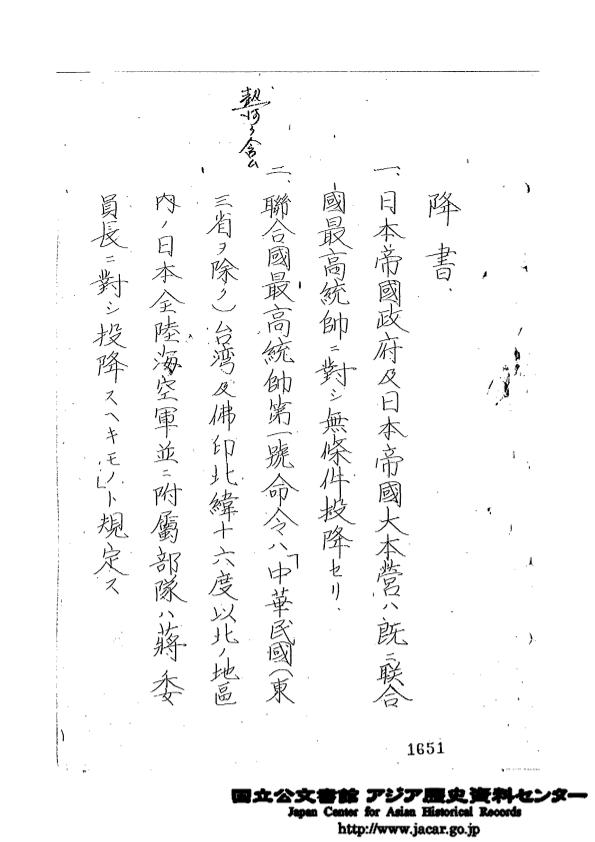
「Instrument of Surrender」JACAR(Japan Center for Asian Historical Records)Ref.C13070337700、First Army Headquarters Memorandum, 1945 (National Institute for Defense Studies of the Ministry of Defense), image 1
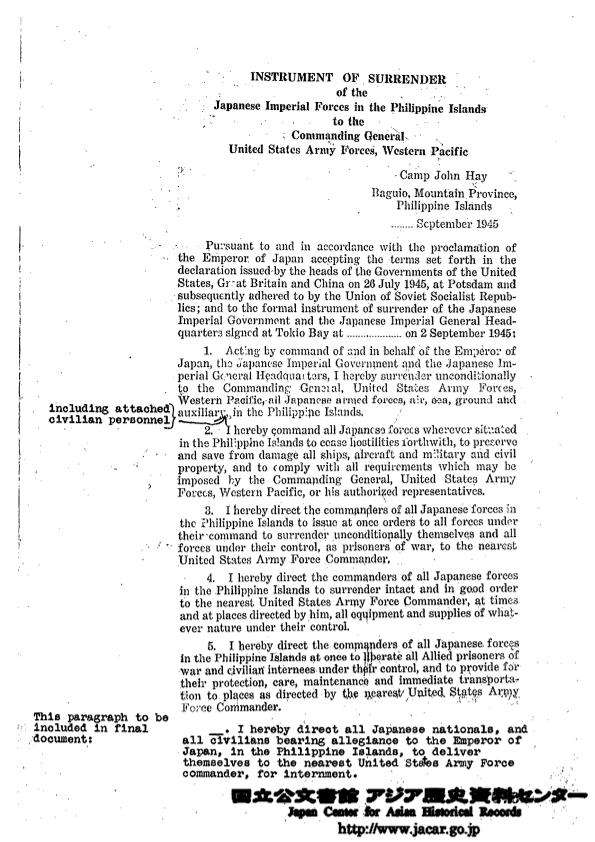
「INSTRUMENT OF SURRENDER of the Japanese Imperial Forces in the Philippine Islands to the Commanding General United States Army Forces, Western Pacific」JACAR(Japan Center for Asian Historical Records)Ref.C14020716900、Surrender document in Luzon(National Institute for Defense Studies of the Ministry of Defense), image 1
(2) Albums of Visits to Japan by Foreign Dignitaries
Beginning with the visit of U.S. Vice President Richard Nixon, the first state guest to visit Japan after the war, records of visits by state guests, official guests, and other distinguished visitors have been made public once 30 years have passed since the visit (Section 7).
Among the leaders from Asian countries who visited Japan between 1955 and the 1960s were the following:
– Phibun Songkhram (Prime Minister of Thailand, 1955),
– U Nu (Prime Minister of Burma, 1955),
– Prince Norodom Sihanouk (Prime Minister of Cambodia, 1955),
– Chang Chun (Secretary-General to the President of the Republic of China, 1957),
– Jawaharlal Nehru (Prime Minister of India, 1957),
– Tunku Abdul Rahman (Prime Minister of Malaysia, 1958),
– Carlos P. Garcia (President of the Philippines, 1958),
– Sukarno (President of Indonesia, 1959),
– Ayub Khan (President of Pakistan, 1960),
– Ferdinand Marcos (President of the Philippines, 1966),
– and Indira Gandhi (Prime Minister of India, 1969), among others.
The albums of visits to Japan by distinguished guests that are available for viewing in their original form (Section 86) contain photographic albums compiled at the time of such visits. Viewed together with the related files, they offer a glimpse of the atmosphere surrounding these occasions.
For example, when Prime Minister Jawaharlal Nehru visited Japan as a state guest in October 1957, in addition to meeting with Japanese leaders he visited the Hiroshima Peace Memorial Museum, Tōdai-ji Temple in Nara, and the Kyoto Imperial Palace. At Ueno Zoo he was reunited with an Indian elephant he had presented in 1949 in response to a request from Tokyo schoolchildren (the elephant was named “Indira” after his daughter). The album “Commemorative Album of the State Visit of Prime Minister Nehru of India” (Section 86) records scenes from this visit.

「Commemorative Photo Album of the Guest of the State Visiting to Japan/Nehru, Prime Minister of India Vol. 1」JACAR(Japan Center for Asian Historical Records)Ref.B21010377900、Commemorative Photo Album of the Guest of the State Visiting to Japan: Nehru, Prime Minister of India Vol. 1(L’.5.0.0.1-12_001)(Diplomatic Archives of the Ministry of Foreign Affairs), image 22
(3) Crown Prince Akihito’s Visit to the United Kingdom (1953)
On March 30, 1953, Crown Prince Akihito (now the Emperor Emeritus), acting as the representative of Emperor Shōwa, departed Yokohama aboard the President Wilson to attend the coronation of Queen Elizabeth II. After traveling via Hawaii, San Francisco, Vancouver, Ottawa, and New York, he arrived in the United Kingdom on April 27.
During his meeting with Queen Elizabeth II, the Crown Prince reportedly spoke actively and fluently in English. When speaking with Prime Minister Winston Churchill, whose hearing had become poor so he leaned closer for the two to converse—the exchange was described at the time as resembling “a grandson speaking with his grandfather.” Contemporary records note that the meeting proceeded in a warm and friendly atmosphere (Section 84, Crown Prince Akihito’s Overseas Tour).
第3巻L.1.1.1.3_003外務省外交史料館.jpg)
「 Visiting the UK」JACAR(Japan Center for Asian Historical Records)Ref.B23010293100、Crown Prince Akihito’s Overseas Trip: Attendance at the Coronation of Queen Elizabeth II of the United Kingdom (March 1953 – October 1953) Vol. 3 (L’.1.1.1.3_003)(Diplomatic Archives of the Ministry of Foreign Affairs), image 10
At the same time, memories of the war remained strong in Britain during the 1950s, particularly because of the issue of the treatment of prisoners of war. Public sentiment toward Japan was therefore not necessarily favorable. For this reason, Japanese officials were cautious about portraying the Crown Prince’s visit as immediate proof of renewed Anglo–Japanese friendship. Ministry of Foreign Affairs evaluations at the time emphasized more modestly that the visit “laid one foundation stone” for the reconstruction of relations between Japan and the United Kingdom.
After attending the coronation ceremony in June, the Crown Prince continued his travels, visiting France, Switzerland, Sweden, and other countries before returning to the United States. He finally returned to Japan on October 12. During this journey he visited 14 countries, making it a tour lasting more than half a year.
(4) The Dai-go Fukuryū Maru Incident (1954)
On March 1, 1954, the Japanese tuna fishing vessel Dai-go Fukuryū Maru (Lucky Dragon No. 5) was operating near Bikini Atoll in the Marshall Islands of Micronesia—outside the danger zone designated by the United States—when it was exposed to fallout from a hydrogen bomb test conducted as part of the Castle nuclear test series. All 23 crew members were exposed to radiation, and the vessel’s radio operator, Kuboyama Aikichi (aged 40), died six months later.
The records compiled under Section 67 contain a wide range of documents related to the incident. Among them are materials summarizing the circumstances of the crew’s exposure based on the vessel’s navigation log and fishing log, preserved in the file titled “Documents Relating to the Dai-go Fukuryū Maru and Other Bikini Atoll Incidents.” The original logbooks themselves, however, are not preserved among MOFA records.
In 1955, the United States paid two million dollars (approximately 720 million yen at the time) not as formal reparations but as ex gratia compensation. At the same time, the incident triggered a rapid rise in domestic and international public opinion calling for the abolition of nuclear weapons, which led to the convening of the First World Conference against Atomic and Hydrogen Bombs in 1955.
References
Asia Center for Historical Records Cooperation Office
“On the Postwar Diplomatic Records Provided to the Japan Center for Asian Historical Records”
Diplomatic Archives Bulletin, No. 36 (2023)